Showing posts with label library read. Show all posts

Friday, 28 February 2025

Winter Stack.

February —
The Great Gatsby | F. Scott Fitzgerald 

A happy revisit to one of my old favourites, prompted by R4's re-imagining by Roy Williams; also brilliantly conceived. 
I was curious as to how much still stemmed from the original & how much had been adapted to suit the Harlem renaissance. 
Returning to it some twenty years later, I was struck by Jay's blind faith & naïve optimism; 'you can't repeat the past'.
Aye, agreed. 


January —
Pageboy | Elliot Page


Insightful.
Vulnerable.
Compelling. 

I was glad to have encountered Page's book; to better educate myself as a trans ally & to pass it along to someone else seeking to do similar. 


'At this point in my life, it didn’t really feel like a choice, there was no other option. I had to choose to engage as my authentic self, or die not trying.' [199]

'There was a spark, a seed, something getting stirred up. My body leaned in, knowing not to stop there, sensing it before my mind did. This flesh vessel, always vastly smarter than me, if only I’d managed to listen.' [237]

Page, Elliot. Pageboy. Doubleday | imprint of Transworld Publishers | Penguin Random House: London, 2023.

Saturday, 29 July 2023

Quest.

Oh, you Pretty.


I had very much planned for this visit during my time in Chicago.
First glimpse giddy.


Some online reading prior had made me realise I wouldn't get so lucky as to be in town on a regular day, complete with library tour as a book fair was scheduled but still... a fair & proper way to enjoy a library nonetheless.

Hence this fan girl left happy after time amongst the stacks.

Right proper placement amongst the stalls  
[Thank you Niffenegger!]
_____________

On so many levels. 
I drafted this poem's finer details into a letter
but didn't keep stock of those for myself.

Saturday, 20 May 2023

Spring Extracts.

May —

Attachments |  Rainbow Rowell

from the 'Annie Spence Recommends' list.
I liked it; it grew on me. And, importantly, the one-sided origin of the attachment was addressed outright, otherwise the snooping would've felt even more awkward. 

Lincoln still thought about Beth. All the time, at first.

He subscribed to the newspaper so that he could read her reviews at breakfast and again at lunch. He tried to figure out how she was doing through her writing. Did she seem happy? Was she being too hard on romantic comedies? Or too generous?

Reading her reviews kept his memory of her alive in a way he probably shouldn’t want. Like a pilot light inside of him. It made him make sometimes, when she was being especially funny or insightful, or when he could read past her words to something true that he knew about her. But the aching faded, too. Things get better — hurt less — over time. If you let them.  [339]

Rowell, Rainbow. Attachments
Orion Books: London, 2012

 _____________

February —

My Name Is Lucy Barton|  Elizabeth Strout

This, I read after talk of a staging so I thought I'd best acquaint myself with the text.

It was ... okay. 
In a nutshell, the quote below encapsulates the shifting narrator that put me in mind of Ishiguro. Strout's fragmentary style and narration meant I didn't warm to the childlike Lucy.  

I am still not sure it’s a true memory, except I do know it, I think.
I mean: It is true. Ask anyone who knew us.
 [119]

I began to feel like the novel had hit its stride in the plot around the workshop with Sarah Payne. A shift came in the storytelling with the directive: 'go to the page'  being followed through & a declaration now of 'abuse', putting a wholly different slant on the childhood detailed thus far [120 / 135].

Other elements recalled Plath's Esther Greenwood: 
the clinical recovery setting post-breakdown; talk of trash & awards  [112]. 

______

... as though they were silently saying You are not one of us, as though I had betrayed them by leaving them. I suppose I had.  [162]

Strout, Elizabeth. My Name Is Lucy Barton
Penguin | Random House: London, 2016.

Friday, 16 December 2022

Autumn Round-Up.

October —
Hamnet | Maggie O' Farrell

It's been talked about for years in my friendship circle, it seems. I was always going to get around to it at some point & then a friend left her copy at work so I loaned her one from the library; once returned, she later lent me hers to read. Circuitous but we got there.
I'd heard that it was hugely moving, potentially a tearjerker of an ending. 
- Is the best book to read, when recently bereaved one, given a key theme is bereavement? Mm. 
Is there a place, a moment in time where the language & lived experience connect & bring comfort? Perhaps. 

- O'Farrell's understated style.
Yes. All the way.
The repetitive nature of pronouns used lending rhythm to speech.

- That Shakespeare, our most famous playwright, goes unnamed; referred to only through nouns: the father, the son, the Latin master, the brother, the husband. 

- His first sighting of, then subsequent meeting with Agnes & the hawk.
- Their partnership; her gifts and their recognition of each other; cleaved unto. 
  Love, sacrifice and compromise; Shakespeare & Agnes' reconciliation [311-321].

- Force of will.

She knows she is meant to have only two children but she will not accept this. She tells herself this ..  She will not let it happen; not tonight, not tomorrow, not any day. She will find that door & slam it shut. [239]

- The journey of the plague from foreign shores to Stratford; a masterpiece  [166-180]

- The journey of Agnes & Bartholomew to London, to the playhouse.

Hamnet, the boy.
It takes a while to arrive at the volta, the crux but it's not want of waiting impatiently for the story to begin. There's already plenty underway by then in learning and knowing how the different family members interact, what their characteristics are. 

Death & its accompaniment in that ... they were there, they were just there; only moments, minutes, days prior. A phone call away. (A line from a recent Guardian article -- 

I thought I had more time. We always think we have more time.

- This, exactly. )

Everywhere he looks: Hamnet. Aged two, gripping the edges of the window ledge ... As a baby, tucked with Judith ... Pushing open the front door ... Catching a ball in its hoop ... Lifting his face from his schoolwork to his father to ask about a tense in Greek ... The sound of his voice, calling ... [280]

He will never come again. She would like to spin the wheel backwards, unmake the skein of Hamnet's death, his boyhood, his infancy, his birth, right back until the moment she and her husband cleaved together ... She would like to unspool it all, render it all back down to raw fleece, to find her way back, to that moment, and she would stand up, she would turn her face to the stars, to the heaven, to the moon, and appeal to them...

There will be no going back. No undoing of what was laid out for them. The boy has gone and the husband will leave and she will stay and the pigs will need to be fed.. and time runs only one way. [287] 

Autumn, when it comes, is terrible too. The sharpness on the air, early in the morning. The mist gathering in the yard. The hens fussing and murmuring in their pen.. The leaves crisping at their edges. Here is a season Hamnet has not known or touched. Here is a world moving forward without him. [291]

- Grief, claustrophobia & the theatre:

It is intolerable. All of it. He feels as though he is caught in a web of absence, its strings & tendrils ready to stick and cling to him, whichever way he turns. Here he is, back in this town, in this house, and all of it makes him fearful that he might never get away; this grief, this loss, might keep him here, might destroy all he has made for himself in London. His company will descend into chaos & disorder without him; they will lose all of their money & disband; they  might find another to take his place  [...]   He might lose his hold on all that he has built there. It is so tenuous, so fragile, the life of the playhouses. He often thinks that, more than anything, it is like the embroidery on his father's gloves: only the beautiful shows, only the smallest part, while underneath is a cross-hatching of labour and skill and frustration and sweat. [281-2]

... he must hold himself separate in order to survive. [305] 

__________________________

November —
Two Across | Jeff Bartsch
Open River | Caleb Azumah Nelson

Two Across, courtesy of Annie Spence's suggestion list
- A coming-of-age tale involving crossword puzzles. Words were going to play a key part in this one. Sign me up! 
I liked it. I was rooting for the two leads, Stanley & Vera through all their wrong turns & misadventures; moments where they'd connect & yet somehow awkwardly still misalign.

Now that he had found her, the urgency and crippling emptiness of his time alone in Boston had eased away [...]  he was carried along by inertia, doped up with the sedative effect of happiness. So he let the months slip by, the grand gesture not coming in the winter, not coming in the spring, comfortably living a non-life with her, a life without substance, written in ink that fades away. [212] 

Spring was cooked away by the increasingly oppressive afternoons of the impending summer, and then summer itself ripened and rotted and was gently laid to rest. From his place on the bench... he observed these changes while the better part of his mind tried to tell itself that he was living an extraordinary life. [178] 

 Would it have been the same novel if Vera had been up front from the start? Probably not. By stretching the story across a good few decades, both characters could grow the heck up, attempt relationships elsewhere & work out where their priorities lay. The cast of supporting characters also integrated well with their goals as parents and/or career women; their changing habits & alliances with each other.
The storyline retained my interest from the faked wedding, throughout additional scandals; pushed onwards by Vera's propensity to bolt whenever things became overwhelming. 

Vera was done with Stanley. Done. That’s what she told herself and that’s what she believed. She made light of it. [...] She made peace with her own mind and finally found a way to tuck him into one of the pockets where all of the accidental characters we encounter throughout our lives eventually take their places, waiting for the archivist of memory, to come poking around again, coming across one here and another one there, and saying, "Ah, there’s Arnold Grant, the funny red-faced boy from first grade" [...] Stanley’s pocket was a very prominent one, but Vera convinced herself that one day it would become as inconsequential and as seldom touched upon as poor Arnold Grant's. [198]

It was funny too. Firstly, for seeing how far these booksmart people had to go to learn a life lesson as well as their shrewd method of communicating across the country, of signalling intent. But secondly, a witty read just in itself. (Pity the humble, practical butter knife!)

He was as useful and reliable as a butter knife, and just as dull. [271]

There was no avoiding the fact that she missed his body. She was flesh and blood after all. But she wouldn’t say his name, or even let it whisper through her mind. If she felt the "S" coming, she would bend it in to quickly bend it into something else. Sss-standard. Sss-starlight.  [...]  Sss-spaghetti. [228]

 My favourite line, 

She was convinced she could spend the rest of her life without a man. Instead, perhaps she would buy one of those nice Japanese teapots.  [226]

Bartsch, Jeff. Two Across. Grand Central Publishing: NY, 2016.

_________

Open River.

Let's start with the good. 
- A friendly recommendation from an actor shared backstage. A book that would've otherwise escaped me, most probably or I may not have loaned at all. 
- Poetic in style. 
- Highly lauded... That's a neither nor here there though. ("Sally Rooney meets Michaela Coel", NYT -- oh, can we not? Can we not just say what it's like rather than having to fall into lazy mash-up territory?) 
- Is it a book for me though? ('what it means to move through the world whilst Black' - Bolu Babalola.) Maybe. Maybe I'd identify with aspects of it; find commonality or find myself challenged. 

There were elements recognisable, certainly in the love story's dynamics:

'It's easier to do this, to open a box & close it quick, seal it with sharp quips. It's easier to let your bodies do the same...'  [45]

'Honestly,' you said. 'I don't know.'
Except you did know. To give desire a voice is to give it a body through which to breathe & live. [...] It was easier to remain silent & hold the desire to yourself. [65]

- the injustices of Stop & Search; the fatigue [59],

The sirens grow closer. All those present grow more fearful in the presence of the siren because when they, the police, are close, you lose your names & you have all done wrong[117]

And there were elements which also left me feeling othered. I didn't know many of the Black names that were filtered into the writing but I did like how readily they were included, as part & parcel of the whole.

There were times when the poetry grasped the moment.

Love as a form of meditation; reaching towards a more honest expression of self[110]

And there were times when the language felt ... much more languorous. I took a break from it for a few weeks & I wasn't exactly rushing to return. 
Being a tale of two lovers in their early twenties, I found that it navel gazes somewhat. It's about the young man and his experience & understanding of how he fits in his community & within the wider world. Yet as much as he's writing & talking about her, the love interest - it's all about him, and all about him & being Just Friends again & again until ...  I started to find that rather cloying. 

To strike out here entirely & draw a line back across my reading past, I think - if I wanted to read poetic prose again - I think I'd return to Jon McGregor. I'm glad to have read it but ... unless his next one were to shake things up, I don't think I'd be rushing to encounter another.

Nelson, Caleb Azumah. Open River. Penguin: UK, 2022. 

Monday, 6 June 2022

Spring Stack || Books About Books

May  June  
Dear Fahrenheit 451 | Annie Spence

Another, possibly now the last, of the books first spotted in Ripon. I came recently to have a look for a second-hand copy & then thought to check the library first. It makes good sense to be reading a book about library reads having borrowed it from a library after all.
   I'd spent a few sleepless mornings back in the pages of my beloved 'Time Traveler's Wife, having read an article on the new HBO series.
  (NB: Not that I'll be going there with the tv series, having not ventured there when the film was released either. I want my Henry and my Claire to stay uninterpreted & unblemished, without any visuals when it comes to encountering them, time after time.)

From the stacks at the Newberry direct to these - and right back again with 'Finchy' & TTTW both featuring in Spence's top reads.
 
 
 Big Stone Gap Series - 
She was crouched on a stool next to your shelf. She had obviously been browsing and been so taken with you she couldn't stop reading. I knew because she had The Look on her face: the Look people get when their brains are so engrossed that they don't care ... Because they're not out in public anymore, they're in whatever world they're reading about. It's beautiful. [30-31]

Killing - 

We can't open ourselves up to that kind of chaos in the stacks. Next thing you know we're alphabetizing the entire collection by title ... [45]   
(God bless Dewey Decimal.)

Easy Rawlins - 
God, I love wandering down dicey alleys with you, roughing up people if they need it, experiencing two decades of Los Angeles, the '40s through the '60s.. Cruising down the strip when I should be in bed with nothing but my favorite PI, Easy & the desert air on my face. But seriously, I should be in bed. I have to be up by six tomorrow. [46]
Future Book Collection -
For now, you'll have to exist in my mind alone. But I've got you all figured out: a room big enough for all of you to fit but small enough to feel cozy & hidden from the rest of the world. Leather couches that are also comfortable, piled with ratty homemade blankets   [...]    A locked door will lead into the room. This will be essential. There will be a doorbell; however, entry is denied unless visitor-candidates answer a series of question posed  [...]  

Once the riffraff is sorted through, serious visitors will only be allowed inside if they agree to speak only about books   [...]   I'll also have a Reading Room Wardrobe, full of clothing Anjelica Houston would wear, which is to say something dramatic & stylish that says "I'm not fucking around." Drapey shit. Lots of otherwise beautiful pieces marred with cigarette burns. Sinister hats. That kind of thing.

But, I mean, obviously, it'll all be about you - the books. You'll all be wrapped in thick pastel marbleized paper, with your titles and authors embossed in gold lettering on the spine. ...  You'll be placed on shelves and in artfully haphazard piles around the room.  [168-9]

.  .  .  .  .
Dear Fahrenheit 451

I'm really glad we met. Reading you has helped kick off my holiday in a most relaxing manner, even reading you in the bath. (I'm so glad you've got that reassuringly waterproof cover.)  I'm enjoying meeting the different books mentioned in you & I'm glad to see we've got a few favourites in common. 
You're certainly making me laugh out loud (Fancy Bookshelf drunken antics!) as well as appreciating having a library service more than ever. It's pretty sweet that because of you I got to visit the one in Didsbury for the first time. 

Thanks for keeping me company over this last week or two. I'd definitely file you in the Fuck It, I'm Just Going To Read Instead of Do What I Need To Do Today section.

Best wishes, 

NW

PS: About that question you posed of keeping notes "& now you have a gabazillion books on your list?" [240]   Aye...  Thanks for that: my MCC Saved List is now even longer & where that stops short, my eBay watch list picks up the slack. That's another couple of months sorted then.   


Spence, Annie. Dear Fahrenheit 451. Icon Books: London, 2019.
____________

April  May
Virginia Woolf at Home | Hilary Macaskill

Another gem spotted in Ripon...  If I hold a sheepish, as opposed to a properly a Woolfish, hand up from having watched The Hours a time or two too many, I must admit I hadn't realised how much Virginia had moved around or changed homes beyond the slightly seismic shift from London to Richmond.

 I enjoyed the insight it gave; learning how much stock was set by regular reading as much as time spent writing; marrying up which books were written in which particular eras & respective house & home of the time.

Tactics around the writing of Flush: 
-- 'she continued to work on it as light relief from the early emergence of her next book, already brewing, already agonising' [135]
&,
-- The Years.. took four years. At her best, she was simply frustrated & longed to be rid of it, to get onto her next project... [135]

... I've certainly been there: desiring to swap to something a little friendlier & a less little foreboding, ready for a change & a chance to Move On.

- Knole again, mentioned - 'the extraordinary mansion that held such sway over Vita', with a glorious double-page illustration that helped me appreciate its magnificent self.

- My laugh out loud moment of houses for sale (inflation overlooked but): 
-- 'And it was cheap, just £300 for the freehold' 
-- 'they made the successful bid, obtaining it for just £700 ... 
on 16 July, they sold the Round House - .. a profit of £20.'

Ach. Ah well.  Interesting too to learn of Woolf's own interest in furnishings & textiles - supporting her sister & Duncan through the purchase or commission of artworks - as well as her bread baking.  :)  Plus Leonard's thoughts - linking in with house as character - the inherited history of a place & what would be their eventual final home together at Monk's House, with books piled high & overflowing from room to room.


Macaskill, Hilary. Virginia Woolf at Home. Pimpernel Press Ltd, 2019.
____________

March  April
Novel Houses: Twenty Famous Fictional Dwellings | Christina Hardyment

There's been a lot of houses with character recently. My reading of this happened to coincide with both a staged version of The House With Chicken Legs & a first viewing of Encanto.

I found the provided Context helpful in Hardyment's desire 

To prompt memories and tempt new readers, I sketch plots, always emphasizing settings. I also explore the lives of the authors in order to establish why they were inspired to create such dwellings.

I enjoyed re-visiting familiar houses & homes I'd known from fiction:  
Castle of Otranto / 221B Baker Street / Knole, Orlando / The Sorceror's Tower - I Capture The Castle / Uncle Tom's Cabin / Manderley, Rebecca / Cold Comfort Farm / Howards End / Wuthering Heights  

Kinship too due to Hardyment's understanding as to 'literary geography' linked to the delight I'd had a young reader. Seeing the village maps of Fern Hollow or Milly Molly Mandy as well as domestic interiors displayed in each book of The Secret Book of the Gnomes series

Saturday, 14 May 2022

Saturday, 15 February 2020

This Bit of Joy...


^ Photo from this blog post by Creative Tourist on
The Little Library, Spinningfield

... Looking forward to a visit to see what's in stock!  :)

Sunday, 5 May 2019

Spring reading,


05/05  I'd been wanting to read Red Dust Road ahead of its NTS tour later this year. And what a joy it was: a voyage of discovery; of parentage & self & identity.
Kicking the story off with the drama of re-meeting her birth father; tracing that moment back in the quest to re-discover her roots and whom, what kind of people, her birth parents are; the plot weaving in & out of childhood memories, 
Incidents of race and difference from growing up & becoming; the love and regard for her adoptive ('true') parents & the aunts from Nairn;  the disappointments of ideals held when reality hits, of opportunities just missed; the camaraderie & care of her friends & new friendships forged helping her find a way across Nigeria; that joyful rendezvous with Sidney, her brother, opening up a new world of possibility and re-connection to her wider Nigerian family. 
*  Reflections on memory (that well-known, well-used family refrain of "remember that time when...?" to relive a moment from childhood); of her parents' relationship - "my parents reinforce each other with memory" as well as their fragility & mortality. 
*  Hitting the nail square on the head with regards to Aberdeen - "depressingly dull or majestic & magical" ... "either the colour of sparkling silver or the drab colour of porridge or fog, depending on your way of seeing it." (132).

Favourite extracts: 
Part of me came from Africa, part of me was foreign to myself, strange to myself since I have never been to the dark continent and could only really have it burning away, hot and dusty, in my mind. It is not so much that being black in a white country means that people don’t except you as, say Scottish; it is that being black in a white country makes you a stranger to yourself. It is not the foreigner without; it is the foreigner within that is interesting. Every time somebody in your own country asks you where you are from; every time you indignantly reply, ‘I’m from here,’ you are subconsciously caught up in asking that question again and again of yourself, particularly when you are a child. (38)
I pictured of the plots of my land in the African landscape of my imagination. It was flat land, not like the Highlands of Scotland. The earth was dark and rich. There was a red dust road. I couldn’t really get much further than that. (42)
... And no matter how much she loved me, no matter how much my dad loved me, there is still a windy place right at the core of my heart. The windy place is like Wuthering Heights, out on open the moors, rugged and wild and free and lonely. The wind rages and batters at the trees. I struggle against the windy place. I sometimes even forget it. But there it is. I am partly defeated by it. You think adoption is a story which has an end. At the point about it is that it has no end. It keeps changing its ending. It infuriates me that this windy place exists at all. It shouldn’t.  ...  I am lucky. I am blessed. And yet still, sometimes, in my dark hours, there is this feeling that I am alone. And I can’t shake it. There’s this ghostly something. I’m only alone in the way that everybody is alone. And yet it seems that the bundle of a child that is wrapped up in the ghostly shawl of adoption does have another layer of aloneness wrapped up in there. (45-46)
Why do we even want to know; surely we know ourselves by now? Why should we have any curiosity, never mind the blazing burning curiosity, the all-consuming insatiable appetite for self-knowledge that some of us feel? If we think of ourselves as puzzles, and our birth parents are part of that puzzle, do we think that finding our parents will answer the puzzle? Surely we are not so naive? The jigsaw can never, ever be completed there will always be missing pieces, or the pieces will be too large and clumsy to fit into the delicate puzzle … You are made already, though you don’t properly know it, you are made up from a mixture of myth and gene. You are part fable, part porridge. (47)
I take off my shoes so the red earth can touch my bare soles. It’s as if my footprints were already on the road before I even got there. I walk into them, my waiting footprints. The earth is so copper warm and beautiful and the green of the long elephant grasses so lushly green they make me want to weep. I feel such a strong sense of affinity with the colours and the landscape, a strong sense of recognition. There is a feeling of liberation, and exhilaration, that at last, at last, last I’m here.... The road welcomes me; it is benevolent, warm, friendly, accepting and for now it feels enough, the red, red of it, the vivid green against it, the long and winding red-dust road. (213-214)
The empty ghost, the wraithlike figure that has stalked me for years seems to be taking off her pale polka-dot dress, slowly, in the sports stadium changing rooms, and hanging it onto a peg. She opens a locker, with her own key, found after years of fumbling, and disappears into its depths. (276)

Kay, Jackie. Red Dust Road.
Picador: London, 2010.

. . . . . 

28/04  I cannot remember how I first heard of Fishbowl. It may have been a mention in the Guardian Books pages perhaps when it first came out in 2015. Either way, its premise caught my attention & amused me so I jotted its name down as a future read. Looking for a remedy book, something to ease me back into reading after MN&JS had taken its toll, I found Fishbowl was in stock at the library. Perfect! 

Chapter Two: "Ian doesn't take his plunge from the balcony until chapter 54" raised a smile. - Okay, Bradley Somer, we're with you; you master of intrigue, you. 

What a read. Witty, philosophical, heart-warming.

It takes a goldfish less than four seconds to fall the distance between the twenty-seventh floor and the sidewalk below. A flash. The time it takes to read a sentence or two. For Ian, it's a lifetime of wonder. 

 ...  I loved how the novel was both four seconds long and yet simultaneously months, years old. The clever weaving-in & out of characters and story-line; pausing each one to return to Ian's apparently imminent demise: the high drama of Connor/Katie/Faye especially  and the background to, and resolution of, Claire's story. 
Lives intersecting, crisscrossing rooms, corridors and streets close by the apartment; "a glimpse into the box" ... Ian's fall serving as a "vital thread that ties humanity together. 
That twist in the tale come the ending. 

Brilliant.
. . . . . 

a brilliant bonkers journey of binaries

Emma Rice's debut play came to town. A chapter a night ahead of watching the performance. Characters I loved, was rooting for, cheering on from the sidelines. 
Great humour, warmth & escapades and a love letter to Shakespeare of sorts. 
Glad to know of the nuances which time on stage could not allow for (the chapter on America omitted entirely); the cleverness in tying up the ending. (Ah Perry!)
. . . . . 


25/02  wanted to like this book. After all, a big chunky read; a epic of sorts. A book that had already been dramatised for tv. A book that promised a collision of worlds, of magic and society,  with an ironic Austen-esque eye cast over its proceedings. 
At times, the plot development caught me up & kept me page-turning; at times, the pace felt to lag & I stalled somewhat but still, would persevere & keep going. 
Then two things occurred: 
- I found myself so irritated by the character of the man with the thistle-down hair that (with a cheating glance to a plot outline), I discovered he wasn't due to die for at least another hundred pages. Ugh, time for a break.
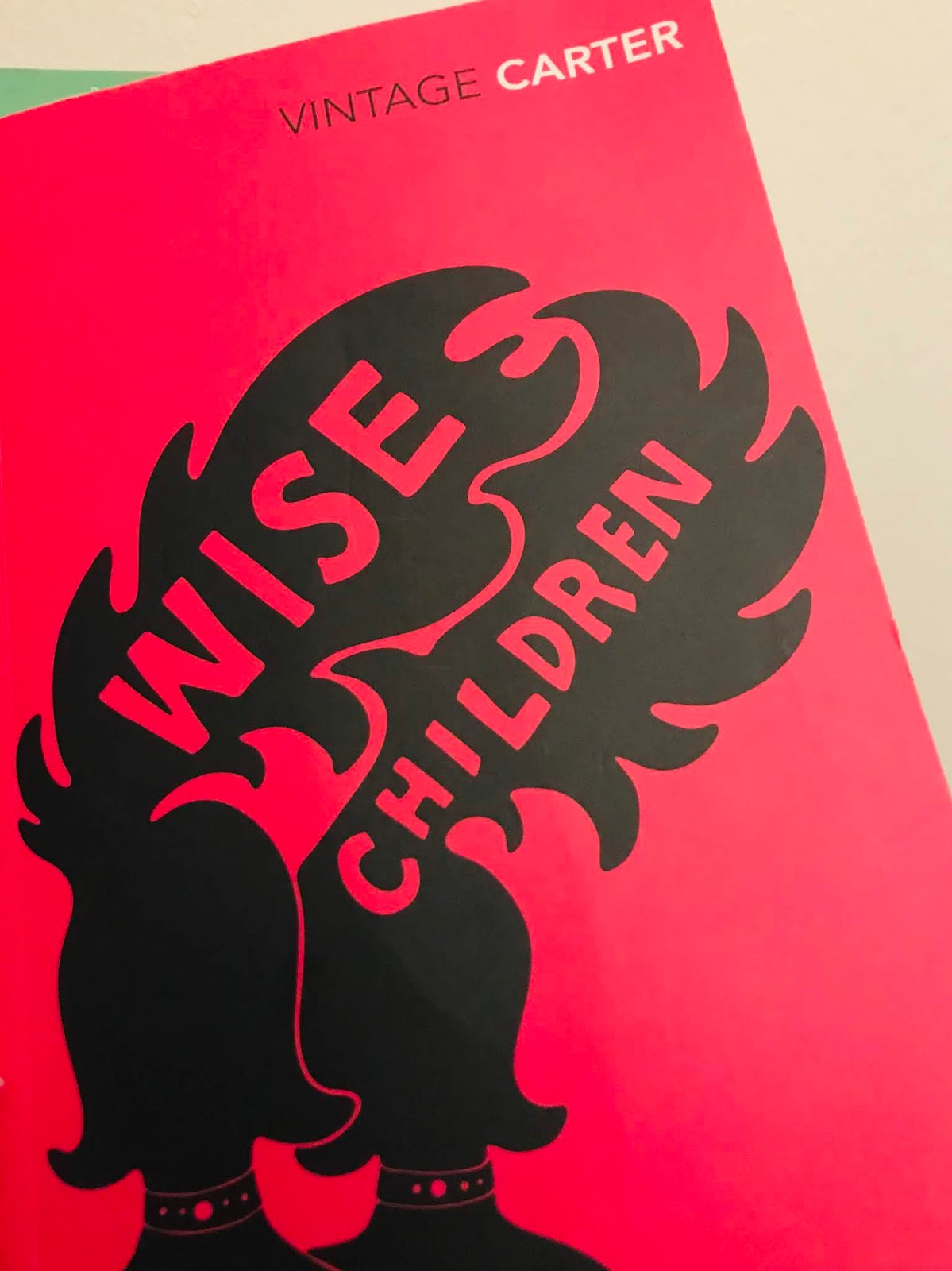
- I swapped over to Wise Children & found it an absolute riot. When I'd finished that brilliant bonkers journey of binaries, MN&JS was still sat waiting on my nightstand. I found myself putting off picking it up again. A couple of weeks passed and so, as much I dislike not finishing a read, that book was putting me off reading altogether. High time to quit & find another, more engaging read. A world I wanted to enter & enjoy.  
.... I wanted to agree & join the crowd of admirers, Gaiman at the front leading the fanfare but. Life's too short to read 'bad' books. Not one for me. Off to the charity shop it went to become someone else's cup of tea instead.

Saturday, 10 November 2018

Happy bookish face,

brand spanking new, hot off the printing press

Tuesday, 26 June 2018


Natasha's Dance joined my To Read list somewhere between 2012 - 2016. It had sat there, dormant for so long I now forget from whom came the nudge to read it. I know it came out of my having read Tolstoy though: one of those well, if you've read x then you should certainly now read y conversations.
  I enjoyed the read: the initial return to the landscapes of my 6th form history class with Peter & Catherine the Greats; an increase in understanding of the role of the peasant class & family estates which I've touched on of late via Chekhov; knowledge gained of folk customs, of Moscow vs. Petersburg; re-meeting the Big Names in culture - the composers, designers, artists, writers. Figes does an excellent job of tying it all in together. 


 Where we closed off - wanting now to read Nabakov's Speak, Memory, 
to revisit the works of Maria Tsvetaeva; 
a study on homesickness that will always chime with me: 

'From such associations the homesick exile constitutes a homeland in his mind. Nostalgia is a longing for particularities, not some devotion to an abstract fatherland.'
..........

' Like most émigrés, [Tsvetaeva] was torn between two different notions of her native land. The first was the Russia that 'remains inside yourself': the written language, the literature, the cultural tradition of which all Russian poets felt themselves a part. ... 'One can live outside of Russia & have it in one's heart,' Tsvetaeva explained... 
The other Russia was the land itself - the place that still contained memories of home. For all her declarations of indifference, Tsvetaeva ccould not resist its pull. Like an absent lover, she ached for its physical presence. She missed the open landscape, the sound of Russian speech, and this visceral web of associations was the inspiration of her creativity. '
...........

For Tsvetaeva the mirage of Russia was the fading memory of her dismantled house .. For Nabokov, in his poem 'The Cyclist', it was the dream of a bike ride to Vyra.. which always promised to appear round the next bend - yet never did.  This nostalgic longing for an irretrievable patch of one's own childhood is beutifully evoked by Nabokov in Speak, Memory (1951). To be cut off from the place of one's own childhood is to watch one's own past vanish into myth.'

'Like Tatiana in Pushkin's Eugene Onegin, the young poet lived in a world of books. "I am all manuscript," Tsvetaeva once said. 

....... reminding me of Michèle Roberts, 
"the self that dances around on white sheets of paper."
_____________________________________

Rossum's ... I'm making my way through it now. Started reading at the behest of a friend. Having come from re-visiting The Tempest, we realised we had on our hands another Miranda, at least in the style of her I.ii one liners only. Domin talks; Helena responds. Sexual assault also known as a "marriage proposal". Ten years pass. ... Not exactly riveting. 

The Kalevela ... Its name also cropped up mid-Natasha's Dance
The Finnish epic. It might travel with me on holiday. Just a few pages in so far. 

Thursday, 14 September 2017

I'll Never Be Young Again
    Daphne du Maurier


The narrator of this one... he didn't win all my favour & sympathies. 
The evolution & breakdown of the relationship between Hesta & Dick was interesting to follow, as well as his efforts to step out of his father's shadow.
______

I resented the idea that when the Hedwig sailed again there would be some strange Norwegian snoring in my cot..,  for places where we have lived intensely become part of ourselves, I always think. However much now Jake and I might resolve to return.., I felt there would be other things claiming us by then and the Hedwig would belong to the past. 
....   

In a flash I can see the progress of that autumn and the coming of winter. [...]I would go on writing and yet be awae of the life that continued aound me, the comfort and the familiarity of little things. There would be Hesta's book lying open on the floor, and her sweater hanging over the back of a chair. On my table were some flowers she had placed there in the morning... Her things and my things, part o each other, part of our life, and the room next door with the one divan in the corner, and my old coat hung on a hook on top of her mackintosh, my shoes lying untidily under the dressing-table, hers beneath a cahir and our tooth-brushes in a jar, and a sponge we shared. All these making up the atmosphere of Hesta and me.. Scraps of conversation..  
....
He was never wrong. I think he always knew what would happen to me. 
Adventure and excitement, sorrow and love were all phases of my life that had to be.