Showing posts with label Update. Show all posts

Saturday, 10 January 2026

Winter Additions.

“Books are safe.”

||  January
Contrary to Whovian—Fahrenheit lore, when turning a page is one of the few activities least likely to exacerbate a shouty shoulder, books do turn somewhat benign. 


Kicking off the New Year with this mixed parcel of reads (‘highbrow’, ‘low-brow’ & ‘eyebrow’, wrote my friend), starting with the most racy & light-hearted of the three; an easy flick-through. 

California Dreamers | Norman Bogner

Being as old than myself, some of Bogner’s attitudes here are certainly contemporaneous (rape games? Mm. Gross.) 
But on the whole, I found I could easily root the most for protagonist Claire, “the jilted small-town beauty who followed [Bobby] West”. 
Her determination to pick herself up, dust herself off & stand her ground in matters of business, romance & love. 
I’m still not entirely convinced of the logical leap from seeing someone sporting camouflage trousers to setting up an entire equivalent Army-&-Navy Store but hey ho, plot must. 
I did appreciate the turn of phrase here,
These were the faces she encountered each day on Rodeo Drive, tough and finicky in stores, but at night their real faces crawled out of the sunlight…” [203-204]

 Bogner, Norman. California Dreamers.
Sphere Books: London, 1982

Next up:
|| February | March | April 

Night Side Of The River Jeanette Winterson

Appropriately enough: 
    What did Albert Camus say? It’s not one thing or the other which leads to madness; it’s the space in between them. 
    I’m living in a space between lives — my past and my future. I’m living in a space between worlds. How could I not feel like a crazy woman. [102]
— Mm. Not so much crazed as caught

This was a slow burn read for me. 
Short story collections aren’t my usual go-to. I’m not sure I’ve actually read a collection since my undergrad years with its Granta broad strokes C.20th (somewhat underwhelming) American anthology (1998 ed.?) 

— All I remember from then is a woman, a girdle & some … turkey fat perhaps? Delightful. 
Give me Uncle Tom’s Cabin over that any day. 
Although perhaps I should actually be following up on Bill Nighy’s ill advised secondary Percival Everett recommendation of James (second to The Trees); anyway 

I’d not picked up any Winterson for a while, crammed as the Ws of my bookcase may be. 
The book was loaned by a former colleague; they’d never quite clicked with her before & yet - this time - the ghost stories paid off. Triumph! 

Favourite chapters include
•  Ghost In The Machine
an awkward love triangle between the living, the dead & the avatar. 

•  The Spare Room
its nod to Spitalfields, of rooms occupied & not, of bad endings, seeking closure & forging resolution. 


This. Oh. 
Absolutely this:


Winterson, Jeanette. Night Side Of The River
Vintage: Great Britain, 2023.

Friday, 28 February 2025

Winter Stack.

February —
The Great Gatsby | F. Scott Fitzgerald 

A happy revisit to one of my old favourites, prompted by R4's re-imagining by Roy Williams; also brilliantly conceived. 
I was curious as to how much still stemmed from the original & how much had been adapted to suit the Harlem renaissance. 
Returning to it some twenty years later, I was struck by Jay's blind faith & naïve optimism; 'you can't repeat the past'.
Aye, agreed. 


January —
Pageboy | Elliot Page


Insightful.
Vulnerable.
Compelling. 

I was glad to have encountered Page's book; to better educate myself as a trans ally & to pass it along to someone else seeking to do similar. 


'At this point in my life, it didn’t really feel like a choice, there was no other option. I had to choose to engage as my authentic self, or die not trying.' [199]

'There was a spark, a seed, something getting stirred up. My body leaned in, knowing not to stop there, sensing it before my mind did. This flesh vessel, always vastly smarter than me, if only I’d managed to listen.' [237]

Page, Elliot. Pageboy. Doubleday | imprint of Transworld Publishers | Penguin Random House: London, 2023.

Thursday, 5 January 2023

Winter Stack


Nick & Norah's Infinite Playlist Cohn & Levithan
Nick stands up and offers his hand to me. I have no idea what he wants, but what the hell, I take his hand anyway, and he pulls me up on my feet then presses against me for a slow dance and it's like we're in a dream where he's Christopher Plummer and I'm Julie Andrews and we're dancing on the marble floor of an Austrian terrace garden. Somehow my head presses Nick's T-shirt and in this moment I am forgetting about time and Tal because maybe my life isn't over. Maybe it's only beginning. 

Cohn, Rachel & David Levithan. Nick & Norah's Infinite Playlist
Electric Monkey: Great Britain, 2014.


The Sense of an Ending | Julian Barnes

Her own shelves held a lot of poetry, in volume and pamphlet form: Eliot, Auden, MacNiece. There were Left Book Club editions of Orwell and Koestler, some calf-bound nineteenth-century novels, a couple of childhood Arthur Rackhams, and her comfort book, I Capture the Castle. I didn’t for a moment doubt that she had read them all or that they were the right books to own. [24] 
At the same time, it made sense that Veronica didn’t give me a simple answer, didn’t do or say what I hoped or expected. In this she was at least consistent with my memory of her. Of course, at times, I’d been tempted to set her down as a woman of mystery, as opposed to the woman of clarity I married in Margaret. True, I hadn’t known where I was with her, couldn’t read her heart or her mind or her motivation. But an enigma is a puzzle you want to solve. I didn’t want to solve Veronica, certainly not at this late date. She been a bloody difficult young woman, 40 years ago, and – on the evidence of this two-word two-finger response – didn’t seem to have mellowed with age. [82] 
… There was a moment in my late twenties, when I admitted that my adventurousness had long since petered out. I would never do those things adolescence had dreamt about. Instead, I mowed my lawn, I took holidays, I had my life. 
But time . . . how time first grounds and then confounds us. We thought we were being mature when we were only being safe. We imagined we were being responsible but were only being cowardly. What we called realism turned out to be a way of avoiding things rather than facing them. Time . . . give us enough time and our best-supported decisions will seem wobbly, our certainties whimsical. [93]

Barnes, Julian. The Sense of an Ending. Vintage: London, 2012.

Friday, 16 December 2022

Autumn Round-Up.

October —
Hamnet | Maggie O' Farrell

It's been talked about for years in my friendship circle, it seems. I was always going to get around to it at some point & then a friend left her copy at work so I loaned her one from the library; once returned, she later lent me hers to read. Circuitous but we got there.
I'd heard that it was hugely moving, potentially a tearjerker of an ending. 
- Is the best book to read, when recently bereaved one, given a key theme is bereavement? Mm. 
Is there a place, a moment in time where the language & lived experience connect & bring comfort? Perhaps. 

- O'Farrell's understated style.
Yes. All the way.
The repetitive nature of pronouns used lending rhythm to speech.

- That Shakespeare, our most famous playwright, goes unnamed; referred to only through nouns: the father, the son, the Latin master, the brother, the husband. 

- His first sighting of, then subsequent meeting with Agnes & the hawk.
- Their partnership; her gifts and their recognition of each other; cleaved unto. 
  Love, sacrifice and compromise; Shakespeare & Agnes' reconciliation [311-321].

- Force of will.

She knows she is meant to have only two children but she will not accept this. She tells herself this ..  She will not let it happen; not tonight, not tomorrow, not any day. She will find that door & slam it shut. [239]

- The journey of the plague from foreign shores to Stratford; a masterpiece  [166-180]

- The journey of Agnes & Bartholomew to London, to the playhouse.

Hamnet, the boy.
It takes a while to arrive at the volta, the crux but it's not want of waiting impatiently for the story to begin. There's already plenty underway by then in learning and knowing how the different family members interact, what their characteristics are. 

Death & its accompaniment in that ... they were there, they were just there; only moments, minutes, days prior. A phone call away. (A line from a recent Guardian article -- 

I thought I had more time. We always think we have more time.

- This, exactly. )

Everywhere he looks: Hamnet. Aged two, gripping the edges of the window ledge ... As a baby, tucked with Judith ... Pushing open the front door ... Catching a ball in its hoop ... Lifting his face from his schoolwork to his father to ask about a tense in Greek ... The sound of his voice, calling ... [280]

He will never come again. She would like to spin the wheel backwards, unmake the skein of Hamnet's death, his boyhood, his infancy, his birth, right back until the moment she and her husband cleaved together ... She would like to unspool it all, render it all back down to raw fleece, to find her way back, to that moment, and she would stand up, she would turn her face to the stars, to the heaven, to the moon, and appeal to them...

There will be no going back. No undoing of what was laid out for them. The boy has gone and the husband will leave and she will stay and the pigs will need to be fed.. and time runs only one way. [287] 

Autumn, when it comes, is terrible too. The sharpness on the air, early in the morning. The mist gathering in the yard. The hens fussing and murmuring in their pen.. The leaves crisping at their edges. Here is a season Hamnet has not known or touched. Here is a world moving forward without him. [291]

- Grief, claustrophobia & the theatre:

It is intolerable. All of it. He feels as though he is caught in a web of absence, its strings & tendrils ready to stick and cling to him, whichever way he turns. Here he is, back in this town, in this house, and all of it makes him fearful that he might never get away; this grief, this loss, might keep him here, might destroy all he has made for himself in London. His company will descend into chaos & disorder without him; they will lose all of their money & disband; they  might find another to take his place  [...]   He might lose his hold on all that he has built there. It is so tenuous, so fragile, the life of the playhouses. He often thinks that, more than anything, it is like the embroidery on his father's gloves: only the beautiful shows, only the smallest part, while underneath is a cross-hatching of labour and skill and frustration and sweat. [281-2]

... he must hold himself separate in order to survive. [305] 

__________________________

November —
Two Across | Jeff Bartsch
Open River | Caleb Azumah Nelson

Two Across, courtesy of Annie Spence's suggestion list
- A coming-of-age tale involving crossword puzzles. Words were going to play a key part in this one. Sign me up! 
I liked it. I was rooting for the two leads, Stanley & Vera through all their wrong turns & misadventures; moments where they'd connect & yet somehow awkwardly still misalign.

Now that he had found her, the urgency and crippling emptiness of his time alone in Boston had eased away [...]  he was carried along by inertia, doped up with the sedative effect of happiness. So he let the months slip by, the grand gesture not coming in the winter, not coming in the spring, comfortably living a non-life with her, a life without substance, written in ink that fades away. [212] 

Spring was cooked away by the increasingly oppressive afternoons of the impending summer, and then summer itself ripened and rotted and was gently laid to rest. From his place on the bench... he observed these changes while the better part of his mind tried to tell itself that he was living an extraordinary life. [178] 

 Would it have been the same novel if Vera had been up front from the start? Probably not. By stretching the story across a good few decades, both characters could grow the heck up, attempt relationships elsewhere & work out where their priorities lay. The cast of supporting characters also integrated well with their goals as parents and/or career women; their changing habits & alliances with each other.
The storyline retained my interest from the faked wedding, throughout additional scandals; pushed onwards by Vera's propensity to bolt whenever things became overwhelming. 

Vera was done with Stanley. Done. That’s what she told herself and that’s what she believed. She made light of it. [...] She made peace with her own mind and finally found a way to tuck him into one of the pockets where all of the accidental characters we encounter throughout our lives eventually take their places, waiting for the archivist of memory, to come poking around again, coming across one here and another one there, and saying, "Ah, there’s Arnold Grant, the funny red-faced boy from first grade" [...] Stanley’s pocket was a very prominent one, but Vera convinced herself that one day it would become as inconsequential and as seldom touched upon as poor Arnold Grant's. [198]

It was funny too. Firstly, for seeing how far these booksmart people had to go to learn a life lesson as well as their shrewd method of communicating across the country, of signalling intent. But secondly, a witty read just in itself. (Pity the humble, practical butter knife!)

He was as useful and reliable as a butter knife, and just as dull. [271]

There was no avoiding the fact that she missed his body. She was flesh and blood after all. But she wouldn’t say his name, or even let it whisper through her mind. If she felt the "S" coming, she would bend it in to quickly bend it into something else. Sss-standard. Sss-starlight.  [...]  Sss-spaghetti. [228]

 My favourite line, 

She was convinced she could spend the rest of her life without a man. Instead, perhaps she would buy one of those nice Japanese teapots.  [226]

Bartsch, Jeff. Two Across. Grand Central Publishing: NY, 2016.

_________

Open River.

Let's start with the good. 
- A friendly recommendation from an actor shared backstage. A book that would've otherwise escaped me, most probably or I may not have loaned at all. 
- Poetic in style. 
- Highly lauded... That's a neither nor here there though. ("Sally Rooney meets Michaela Coel", NYT -- oh, can we not? Can we not just say what it's like rather than having to fall into lazy mash-up territory?) 
- Is it a book for me though? ('what it means to move through the world whilst Black' - Bolu Babalola.) Maybe. Maybe I'd identify with aspects of it; find commonality or find myself challenged. 

There were elements recognisable, certainly in the love story's dynamics:

'It's easier to do this, to open a box & close it quick, seal it with sharp quips. It's easier to let your bodies do the same...'  [45]

'Honestly,' you said. 'I don't know.'
Except you did know. To give desire a voice is to give it a body through which to breathe & live. [...] It was easier to remain silent & hold the desire to yourself. [65]

- the injustices of Stop & Search; the fatigue [59],

The sirens grow closer. All those present grow more fearful in the presence of the siren because when they, the police, are close, you lose your names & you have all done wrong[117]

And there were elements which also left me feeling othered. I didn't know many of the Black names that were filtered into the writing but I did like how readily they were included, as part & parcel of the whole.

There were times when the poetry grasped the moment.

Love as a form of meditation; reaching towards a more honest expression of self[110]

And there were times when the language felt ... much more languorous. I took a break from it for a few weeks & I wasn't exactly rushing to return. 
Being a tale of two lovers in their early twenties, I found that it navel gazes somewhat. It's about the young man and his experience & understanding of how he fits in his community & within the wider world. Yet as much as he's writing & talking about her, the love interest - it's all about him, and all about him & being Just Friends again & again until ...  I started to find that rather cloying. 

To strike out here entirely & draw a line back across my reading past, I think - if I wanted to read poetic prose again - I think I'd return to Jon McGregor. I'm glad to have read it but ... unless his next one were to shake things up, I don't think I'd be rushing to encounter another.

Nelson, Caleb Azumah. Open River. Penguin: UK, 2022. 

Friday, 30 September 2022

Summer | September Stack.


September   
The Bad Beekeepers Club | Bill Turnbull

I placed a reservation with MCCL for TBBC the same week as Bill Turnbull died. I remembered that when he'd retired, articles written had referenced his bees. This happened to coincide with my signing-up to become a beekeeper at work so reading his book just made plain good sense. 

It's very conversational in style, almost chatty to a degree and very self-deprecating from the outset as to how much he got wrong. Sometimes I like this as it can be humble and self-aware; sometimes it'd be nice to hear or learn of a few successes as well. But here, the humour & the storytelling mostly worked. Particularly on thrift,
... If not the mother, then necessity is probably the rather wrinkled & stingy maiden aunt of the Bad Beekeeper's sense of invention. [120]
What was much more valuable was factual background to bee characteristics. I'd started to pick up a fair bit through practical means on my rooftop visits but I was certainly learning here too - not just of 'the girls' but also about males, the drones & how
[a] bee has five eyes. And thanks to what’s called ‘flicker fusion potential’, it can see at the equivalent of three hundred frames a second. If bees went to the cinema, the film would appear to them as a long sequence of still pictures. In other words they could see your hand moving like it’s a slow-motion action replay. [8]

 &

CIVILISATION What's the smoker for? [...]
Smoke makes the bees think that there’s a fire nearby and they may have to evacuate the hive. They quickly eat some of the honey to prepare for the journey. When the smoke passes, they realise they won’t have to leave after all. By this time though, they’ve had so much to eat that their mood has improved and so they are more placid.

& Waggle Dance

First of all they match up and down a bit to indicate the position of the Sun. Then they veer off at an angle to indicate the compass bearing of the flowers they are guiding other bees too. They also shake their bodies at a certain frequency to let the others know just how far they have to go. And here’s the really interesting bit: the other bees can’t see them doing it. They feel the dance through their antennae. It’s outstanding when you think about it. [29]

but lastly, mostly:  

FELLOWSHIP Ultimately, though, it’s all about the union with the bees. Forget about the honey, and the candle making, and the mead and all the other little bits and pieces you can harvest from the hive, like pollen and propolis. The real joy for me is just in keeping the bees, literally. From the moment you lift off the lid on the hive and peer inside, you are entering another world, and leaving your own. [243]

— Amen to that.

Turnbull, Bill. The Bad Beekeeper's Club. Sphere: UK, 2011.

________

August - September 
The Unlikely Escape of Uriah Heep | H.G. Parry

Millie Radcliffe-Dix:  
Would you like some of this sponge cake by the way? I'm having some.  It's important to keep your strength up on adventures.  [217] 

: A borrowed read from some friends I happened to trade books with this summer. I'm not by any measure a straight-up consumer of SFF but there are certain ones which neatly intersect the genre whilst providing something extra elsewhere in keeping with my literary tastes. This particular read does just that, not least from its world inhabited by familiar characters from fiction.

Parry's Acknowledgments calls out a number of names, all bar one I'd knew of, had studied &/or read something by...

... thanks to Charles Dickens, Oscar Wilde, Mary Shelley, Arthur Conan Doyle, Jane Austen, Margaret Mahy, Roald Dahl, C.S. Lewis, Emily Brontë, and the other authors whose creations grace the pages of this book. You’re wonderful. Your words are wonderful. I’m sorry for what I did to them. 

But it's also more than that. There's a real warmth & a care in how Parry's characters are cultivated & developed from their fictional origins; a love of reading; a world very much shaped by literary analysis (or for me, Lit Crit). Having five different Darcys (one sure nod to CF / BBC included) tickled me no end. And whilst I've never cared much for Dickens, I'm familiar enough with the ins & outs of his works to recognise & understand Copperfield, Uriah, Artful, Satis House, Havisham, Fagin & so on... If anything, the large equivalent dosage of Conan Doyle certainly helped shout-out here for Henry (Hound Mk. 2), the depiction of Holmes as a righter of wrongs & a lovely bit of plot leading via 'the fly in the ointment' directly to:

“Moriarty,” Charlie said. “The Napoleon of crime.” The woman who wasn't Beth smiled. “Yes. And may I say, Dr. Sutherland, but it is a dangerous habit to finger books in the pockets of one’s dressing gown.” [364]

Well played indeed.  

I'm not sure I always knew exactly where the storyline was headed. Sometimes there felt to be a lot of signposting around The Coming Of The New World without much development. But there was enough to run with or to keep track of & Parry was meanwhile plugging the gaps of past, present & future. Diary entries neatly breaking up the novel. Helping me thus in turn, as a reader, to better understand how Robert and Charles had been shaped as well as their fraternal relations.

It was the latter part of the book, with the new world's arrival, the showdown which became the most compelling. A particularly TTTW moment such as when the Henrys crossover in time. Yup --

If you have difficulty believing your brother isn’t real, try seeing him dead or dying in two vastly different forms, as two vastly different people, while he’s standing behind you both times as the person you grew up with. And then try to tell yourself it isn’t killing you inside. [390]

Beautiful, beautiful writing & (2) I don't tend to envisage or picture much when I'm reading but this I could see as it took me right back to MIF '19's Atmospheric Memory...  

He was David Copperfield, and Sherlock Holmes, and Charles Dickens. He was Dr. Charles Sutherland, author of the world that was crumbling around us. He was words, and thought, and memory. He was a creature of metaphor and simile, of hopes and autobiography and dead people. And he was my brother. [426]

Buildings folded over like the pages of a book. Liminal space. The space between two worlds. Where the light was strongest, there were no buildings—at least, none of bricks and mortar. They shone through with words. The city at the edges dissolved into block text, and the ground under my feet were shifting with printed sentences. In places the buildings looked like thinly painted watercolor over newsprint. In others there were holes torn through the walls or across the sky itself, and words teemed from those holes—or out of them, I couldn’t tell. Everything was in motion. And noise. There was so much noise. [425]

I saw the city, Charley’s London, solid and real, made of words and thoughts and ideas and interpretation, sprawling out as far as I could see. It was disappearing: not to nothing, as Moriarty had feared, but into something I couldn’t begin to understand. It was passing into pure language. In another moment, perhaps, I would disappear with it. [427]

End resolution? Yeah... it wrapped up well. That last scene was particularly cosy after Robert's years of bubbling frustration / irritation with Charley & the company he'd been keeping. 

  Specific elements I enjoyed:
- Parry's writing-up of Wellington & her emphasis on the city's topography
- Charley's bookstrewn house (the Woolfs again!) 
- the dynamic between Millie & Dorian Gray 
- Heathcliff & his 'glorious' necessary death 
- The Street (& five entire cohabiting Darcys)
- different manifestations of David Copperfield 
- Millie & Charley's friendship 

Beastly to discover that Millie was fully fictional though. That's the kind of (plucky heroine & near scrapes) series I would've easily devoured in childhood. Darn! 

Parry, H.G. The Unlikely Escape of Uriah Heep. Orbit: UK, 2020.
_______________

August - October  
— The Ruthless Elimination of Hurry | John Mark Comer  (underway)

Monday, 6 June 2022

Spring Stack || Books About Books

May  June  
Dear Fahrenheit 451 | Annie Spence

Another, possibly now the last, of the books first spotted in Ripon. I came recently to have a look for a second-hand copy & then thought to check the library first. It makes good sense to be reading a book about library reads having borrowed it from a library after all.
   I'd spent a few sleepless mornings back in the pages of my beloved 'Time Traveler's Wife, having read an article on the new HBO series.
  (NB: Not that I'll be going there with the tv series, having not ventured there when the film was released either. I want my Henry and my Claire to stay uninterpreted & unblemished, without any visuals when it comes to encountering them, time after time.)

From the stacks at the Newberry direct to these - and right back again with 'Finchy' & TTTW both featuring in Spence's top reads.
 
 
 Big Stone Gap Series - 
She was crouched on a stool next to your shelf. She had obviously been browsing and been so taken with you she couldn't stop reading. I knew because she had The Look on her face: the Look people get when their brains are so engrossed that they don't care ... Because they're not out in public anymore, they're in whatever world they're reading about. It's beautiful. [30-31]

Killing - 

We can't open ourselves up to that kind of chaos in the stacks. Next thing you know we're alphabetizing the entire collection by title ... [45]   
(God bless Dewey Decimal.)

Easy Rawlins - 
God, I love wandering down dicey alleys with you, roughing up people if they need it, experiencing two decades of Los Angeles, the '40s through the '60s.. Cruising down the strip when I should be in bed with nothing but my favorite PI, Easy & the desert air on my face. But seriously, I should be in bed. I have to be up by six tomorrow. [46]
Future Book Collection -
For now, you'll have to exist in my mind alone. But I've got you all figured out: a room big enough for all of you to fit but small enough to feel cozy & hidden from the rest of the world. Leather couches that are also comfortable, piled with ratty homemade blankets   [...]    A locked door will lead into the room. This will be essential. There will be a doorbell; however, entry is denied unless visitor-candidates answer a series of question posed  [...]  

Once the riffraff is sorted through, serious visitors will only be allowed inside if they agree to speak only about books   [...]   I'll also have a Reading Room Wardrobe, full of clothing Anjelica Houston would wear, which is to say something dramatic & stylish that says "I'm not fucking around." Drapey shit. Lots of otherwise beautiful pieces marred with cigarette burns. Sinister hats. That kind of thing.

But, I mean, obviously, it'll all be about you - the books. You'll all be wrapped in thick pastel marbleized paper, with your titles and authors embossed in gold lettering on the spine. ...  You'll be placed on shelves and in artfully haphazard piles around the room.  [168-9]

.  .  .  .  .
Dear Fahrenheit 451

I'm really glad we met. Reading you has helped kick off my holiday in a most relaxing manner, even reading you in the bath. (I'm so glad you've got that reassuringly waterproof cover.)  I'm enjoying meeting the different books mentioned in you & I'm glad to see we've got a few favourites in common. 
You're certainly making me laugh out loud (Fancy Bookshelf drunken antics!) as well as appreciating having a library service more than ever. It's pretty sweet that because of you I got to visit the one in Didsbury for the first time. 

Thanks for keeping me company over this last week or two. I'd definitely file you in the Fuck It, I'm Just Going To Read Instead of Do What I Need To Do Today section.

Best wishes, 

NW

PS: About that question you posed of keeping notes "& now you have a gabazillion books on your list?" [240]   Aye...  Thanks for that: my MCC Saved List is now even longer & where that stops short, my eBay watch list picks up the slack. That's another couple of months sorted then.   


Spence, Annie. Dear Fahrenheit 451. Icon Books: London, 2019.
____________

April  May
Virginia Woolf at Home | Hilary Macaskill

Another gem spotted in Ripon...  If I hold a sheepish, as opposed to a properly a Woolfish, hand up from having watched The Hours a time or two too many, I must admit I hadn't realised how much Virginia had moved around or changed homes beyond the slightly seismic shift from London to Richmond.

 I enjoyed the insight it gave; learning how much stock was set by regular reading as much as time spent writing; marrying up which books were written in which particular eras & respective house & home of the time.

Tactics around the writing of Flush: 
-- 'she continued to work on it as light relief from the early emergence of her next book, already brewing, already agonising' [135]
&,
-- The Years.. took four years. At her best, she was simply frustrated & longed to be rid of it, to get onto her next project... [135]

... I've certainly been there: desiring to swap to something a little friendlier & a less little foreboding, ready for a change & a chance to Move On.

- Knole again, mentioned - 'the extraordinary mansion that held such sway over Vita', with a glorious double-page illustration that helped me appreciate its magnificent self.

- My laugh out loud moment of houses for sale (inflation overlooked but): 
-- 'And it was cheap, just £300 for the freehold' 
-- 'they made the successful bid, obtaining it for just £700 ... 
on 16 July, they sold the Round House - .. a profit of £20.'

Ach. Ah well.  Interesting too to learn of Woolf's own interest in furnishings & textiles - supporting her sister & Duncan through the purchase or commission of artworks - as well as her bread baking.  :)  Plus Leonard's thoughts - linking in with house as character - the inherited history of a place & what would be their eventual final home together at Monk's House, with books piled high & overflowing from room to room.


Macaskill, Hilary. Virginia Woolf at Home. Pimpernel Press Ltd, 2019.
____________

March  April
Novel Houses: Twenty Famous Fictional Dwellings | Christina Hardyment

There's been a lot of houses with character recently. My reading of this happened to coincide with both a staged version of The House With Chicken Legs & a first viewing of Encanto.

I found the provided Context helpful in Hardyment's desire 

To prompt memories and tempt new readers, I sketch plots, always emphasizing settings. I also explore the lives of the authors in order to establish why they were inspired to create such dwellings.

I enjoyed re-visiting familiar houses & homes I'd known from fiction:  
Castle of Otranto / 221B Baker Street / Knole, Orlando / The Sorceror's Tower - I Capture The Castle / Uncle Tom's Cabin / Manderley, Rebecca / Cold Comfort Farm / Howards End / Wuthering Heights  

Kinship too due to Hardyment's understanding as to 'literary geography' linked to the delight I'd had a young reader. Seeing the village maps of Fern Hollow or Milly Molly Mandy as well as domestic interiors displayed in each book of The Secret Book of the Gnomes series

Thursday, 25 November 2021

Autumn Stack | 2

There are so many words involved in being a bibliophile and by that, I don’t mean the words themselves but more so about the process of reading, of stocking up To Read piles. 

I was nearing the end of Sourdough & wasn’t quite ready for the book to be over. Which got me wondering whether there was a word too, for prolonging an ending & resisting its conclusion?
  So I paused my reading progress & looked around for another so I could still stay within the un-concluded realms of Lois Clay, the Clement Street starter & the Vitruvian.
  Chancing across the Bookery, I’d picked up Austenland. A Mr Darcy theme; hopefully a fun, lighter read when in between books. Or avoiding endings. 

I liked it enough. 
You do have to suspend your disbelief to get behind the concept that women would pay actual money to sign up for a Regency immersion experience with its rigid Code of Conduct. 
Interlinking chapters by boyfriend recaps certainly aids the reader’s appreciation of Jane’s past love affairs: the crushes, the relationships, the disappointments. 

But it did also bug me at times… I sincerely hope to never read another ‘Zing!’ in my life. Not the most believable of interior monologue moments, however heroine Jane is finding her way through proceedings. 
   I also wondered if Hale was consciously over-egging the pudding with her signifiers of the fact that the grumpiest man in the room couldn’t possibly be a love interest despite the very characteristic being stamped through as Total Darcy. Perhaps the reader is meant to know she can only be fooling herself but then wouldn’t an Austen reader be far smarter about that?

Having Martin’s character with the IRL intrusion was a good foil however & — spoilers! — aided the neat twist that even that seemingly covert flirtation was still overseen & orchestrated as part of the package.

She had seen her life like an intricate puzzle, all the boyfriends like dominoes, knocking the next one and the next, an endless succession of falling down. But maybe that wasn’t it all. She’d been thinking so much about endings, she’d forgotten to allow for the possibility of the last one, one that might stay standing. 
                                                                                                                     [192] Hale, Shannon. Austenland. 2007

I can take the novel’s tied-up-in-a-bow ending. Although my own learned experience rather resisted the flippancy present in “There’s bound to be work for an attractive British actor..”  

— Yes, mate. No visa required, just come on in. Mm!

I discovered Hale's Alternate Endings later whilst reading further online. And well, a part of me could’ve easily taken Independent Jane instead, minus any kind of rom-com conclusion in its entirety. 
That said, 
having seen a few clips of the movie's trailer, a confrontation in the airport between Jane’s Regency rivals strikes me as being much more palatable than say, having one’s apparent love interest fly halfway across the world to turn up on your doorstep. Romantic? Nah, sorry. Somewhat weird & stalker-ish? Mhmm…

I liked it enough; a fun, lighter read whilst between other books.

Sunday, 3 October 2021

Autumn Stack

The Wild Places 
I first encountered Robert McFarlane being namechecked in an article from Guardian's Review (RIP).  The writer had grouped together Daisy Johnson (Fens) with McFarlane's Underland alongside other authors writing similarly on landscape or wildness.         In sharing my new-found insight, I discovered my bookish friends were strides ahead of me - had got the book, been to the Waterstones signing; fully immersed.  Once known, I kept coming across him still in later works; through the beautiful, imaginative 'Lost Words collaboration with Jackie Morris. 

TWP I found in my local eco-friendly store. I was bending below the shelf to recycle a small stash of occasional green milk bottle tops when I saw too the book exchange pile.  From there, south then north; west to east on train journeys, tram journeys; plus a stint working away from home.  McFarlane propped open over breakfast, weighted with knife & pepper pot to hold the page.  Journeying myself, crossing through the sunny Peak District back to Manchester whilst reading of other journeys taken far further south. 

A revelation, 'Wrath' means not 'anger', but 'turning-point' [Cape, 133], 
& some choice extracts - -

Wildness, in Coleridge's account, is an energy which blows through one's being, causing the self to shift into new patterns, opening up new perceptions of life. 
[Ridge, 209] 
. . . 

On The Gentle Art by Stephen Graham 
Anyone who could sincerely observe that 'There are thrills unspeakable in Rutland, more perhaps than on the road to Khiva' was, in my opinion, to be cherished. Graham was also one among a line of pedestrians who saw that wandering & wondering had long gone together; that their kinship as activities extended beyond their half-rhyme. And his book was a hymn to the subversive power of pedestrianism: its ability to make a stale world seem fresh, surprising and wondrous again, to discover astonishment on the terrain of the familiar.
[Holloway, 230]

> Reading this in 2021, a year on from the pandemic & impact of lockdown ... It's a sentiment many of us came to recognise or if not, remember through staying local, holding still and watching the seasons change in close proximity, in one's own neighbourhood. 

Most of these places .. were not marked as special on any map. But they became special by personal acquaintance. A bend in a river, the junction of four fields, a climbing tree.. a fragment of woodland glimpsed from a road regularly driven along - these might be enough. Or fleeting experiences, transitory, but still site-specific: [. . .]  the fall of evening light upon a stone...

 [. . .]   It seemed to me that these nameless places might in fact be more important than the grander wild lands that for so many years had gripped my imagination. Taken together, the little places would make a map that could never be drawn by anyone, but which nevertheless existed.. I began to make a list in my head of what would be on my own map of private or small-scale wild places...  [Holloway, 236-7]

>  This fully engaged my attention as a reader. I may never climb a beech tree (my own climbing efforts ended in injury & a badly sprained ankle, aged 10) - nor attempt to scale Sgurr Dearg above Coruisk - nor sleep out on iced-over tarn in a blizzard in the Peaks [Ridge, 196, 199] ... but I can collate from memory a list of my very own places.
. . . 

Grief played its tricks: I kept forgetting that he had died, thinking for a second I could ring him up to ask him something, or call over to see him. I had known him for fewer than four years, but friendship with Roger did not seem to follow the normal laws of time. 
We had shared adventures, and there would have been others to come, but for the cancer.
I had wanted to know Roger as he aged into his seventies and eighties, for he would have grown old, properly old, so superbly. He was an expert in age: in its charisma and its worth. Everything he owned was worn, used, re-used. If anyone would have known how to age well, it would have been Roger.  
[Storm-Beach, 266-7]

_____________

"There is wildness everywhere if we only stop in our tracks & look around us." 
~ Roger Deakin

. . .  _____________  . . . 

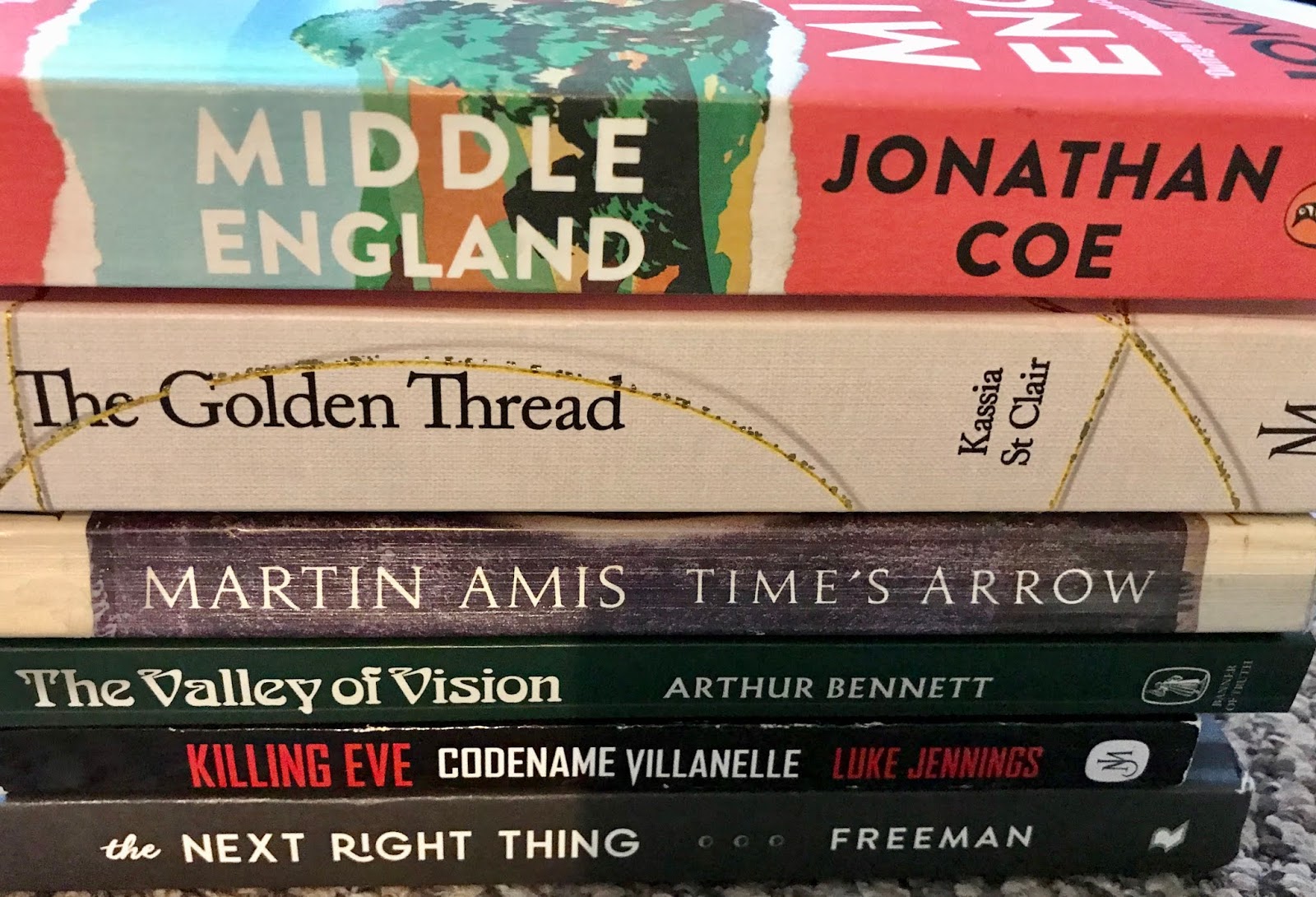
The Golden Thread
A bit of a voyage through time - & space. 
A good read which educated & entertained.

Some stand-out chapters: 
 
Surf Dragons - The Vikings Woollen sails
 A King's Ransom: Wool in Medieval England
 Solomon's Coats: Cotton, America & Trade
 Workers in the Factory: Rayon's Dark Past

Some of what was unpacked I'd encountered of before - from social history, from C19th US Culture classes - but I enjoyed learning more of the specifics too. The challenges & obstacles faced across time by Vikings, peasants, enslaved African Americans with regards to cloth as well as the societal changes which fabric brought about. 
Alongside these, the combination of the historic & the modern - how textiles were first deployed, then improved & developed for mountaineering & for space travel (Layering In Extremis & Under Pressure respectively). 

 . . . _____________ . . . 

Our House
Mmm. Yeah. 
No. )

It didn't help that this was my first fiction read in a long while & I was ready for something Good. I'd thought the premise sounded rather intriguing. But perhaps the  l a r g e  & thus easy-to-read, accessible nature should've sounded an even louder alarm bell as I started? 
At my most constructive, I'm going to say that when the plot hit its middle territory there was something of a recovered stride & so the tangled web became slightly more engaging.
I could have lived without every single one of the hip hashtag social media malarkey which ended each chapters & grated horribly. Reveal of Saskia = Merle brought absolutely nothing to the plot line other than a bunch of wholly unnecessary additional pages. (Couldn't the women just have been friends? Was there really so much need for betrayal to solidarity?)
A bit too much froth but hey, the same storyline came up in national news so the truth is certainly proven to be stranger than fiction & entirely plausible now, I guess.

Monday, 15 June 2020

Spring Stack,


Middle England | Jonathan Coe
...  Not a book I would've likely picked up myself but nonetheless a book lent to me by a friend: "it's about Brexit" ... & then some. Coe's array of characters, intersecting, made for some good dynamics & interesting relationships.
Aspects I liked: Sophie's study trip; Sophie's cruise. 
The evening of the London 2012 Olympics, across the different households. 
Benjamin & Doug were perhaps my two favourites in their roles of novelist & journalist.
Aspects I could've easily taken a pass on
Sophie & Ian. Ian's mum. ... In fact, most of the cast list really as they were, for the most part, pretty disagreeable / selfish / presumptuous / niggling / plain bonkers...

Time's Arrow | Martin Amis 
...  A good revisit. Last time I read the novel was in my final year as an undergrad. I'd remembered its connection to Betrayal, Benjamin Button - a narrative reversed but my memory had mashed it up with its progenitor, Slaughterhouse-Five.
  It's just as smart as I'd remembered. Sometimes I found myself reading conversations forward, from the bottom up so as to gain a sense of where the backwards conversation was headed / had come from. Amis' foreshadowing of elements such as the bomb baby works to spur the reader onwards, seeking to uncover this memory of the 'future past'. 

'How many times have I asked myself: when is the world going to start making sense? Yet the answer is out there. It is rushing towards me over the uneven ground.'  [123]
In the later phase of the book, my reading slowed as the Jewish race comes into being, 'created from the air' and Amis addresses the atrocity of poisons 'extracted' through the experiments of the protagonist, who has become, by this point: Odilo Unverdorben
  It's harder going in the penultimate chapters because what one reads stands in a false mirror of events: creation in lieu of destruction, birth in lieu of life. I'm glad that we, as readers, also have the soul's voice as our narrator, separating off body & flesh & negative action. 

  'Into Tod's mind, of course, I cannot see. But I am the hidden sharer of his body.'  [64]
My revisit of TA has made me want to return to some of Primo Levi's texts too. 


Codename Villanelle | Luke Jennings
A good insight into the foundations of what was used & tweaked by PWB to become the BBC tv programme, Killing Eve. 
Interesting to learn - SPOILERS ALERT - more of Villanelle/Oxana’s childhood, her relationship with her father; to discover that Carolyn Martens was dreamed up as a female alternative to Eve’s inevitably male boss (thank god; the series is so much the better for having Fiona Shaw kick so much ass); discovering more of Eve & Nick’s relationship and finding, by the end, that it’s Konstantin who gets the shove and not the dangerous ex-lover.


The Next Right Thing | Emily P. Freeman
... I'm not a massive fan of self-help books & Christian life application books (the Bible aside) sometimes make me feel like I've hit a wall. Not the easiest of things to concentrate on but Freeman's book got the best out of me. It's helped by the fact that the text & her podcast series also interconnect. So thanks to audio, a sense was gained of Freeman's outreach & overall approach: not an admonishment but an encouragement. A gentle nudge to retrain oneself to think differently, respond differently & to do so out of love.


1.  Martin Amis: Time's Arrow
     Jonathan Cape, 1991.