26 years of this wonderful book.
Thank you Sam McBratney (1943 - 2020).
Illustration: Anita Jeram
'How many times have I asked myself: when is the world going to start making sense? Yet the answer is out there. It is rushing towards me over the uneven ground.' [123]
'Into Tod's mind, of course, I cannot see. But I am the hidden sharer of his body.' [64]My revisit of TA has made me want to return to some of Primo Levi's texts too.

Sad and tired as Linda was, she could not but perceive the beauty of Paris that summer morning as she drove across it to the Gare du Nord. Paris in the early morning has a cheerful, bustling aspect, a promise of delicious things to come, a positive smell of coffee and croissants, quite peculiar to itself. . . . .
The people welcome a new day as if they were certain of liking it, the shopkeepers pull up the blinds serene in the expectation of a good trade, the workers go happily to their work, the people who have sat up all night in night clubs go happily to their rest, the orchestra of motor-car horns, clanking trams, a whistling policeman tunes up for the daily symphony, and everywhere is joy.
This joy, this life, this beauty did not underline poor Linda's fatigue and sadness, she felt it but was not of it. She turned her thoughts to old familiar London, she longed above all for her own bed, feeling as does a wounded beast when it crawls home to its lair. She only wanted to sleep undisturbed in her own bedroom. [131-2]
“Oh, don’t pity me. I’ve had eleven months of perfect and unalloyed happiness, very few people can say that, in the course of long lives, I imagine.”
I imagine so too. Alfred and I are happy, as happy as married people can be. We are in love, we are intellectually and physically suited in every possible way, we rejoice in each other’s company, we have no money troubles and three delightful children. And yet, when I consider my life, day by day, hour by hour, it seems to be composed of a series of pin-pricks. Nannies, cooks, the endless drudgery of housekeeping, the nerve-racking noise and boring repetitive conversation of small children (boring in the sense that it bores into one‘s very brain), their absolute incapacity to amuse themselves, their sudden and terrifying illnesses, Alfred’s not infrequent bouts of moodiness, his invariable complaint at the meals about the pudding, the way he will always use my toothpaste and will always squeeze the tube in the middle. These are the components of marriage, the wholemeal bread of life, rough, ordinary, but sustaining; Linda had been feeding upon honey-dew, and that is an incomparable diet.’ [169-170]
Both [Tony & Christian] would have spoken to her exactly, in every respect, as if she had been some chap in the club. Fabrice talked to her, at her, and for only her, it was absolutely personal talk, scattered with jokes and illusions private to them both. She had a feeling that he would not allow himself to be serious, that if he did he would have to embark on tragedy, and that he wanted her to carry away a happy memory of his visit. But it also gave an impression of boundless optimism and faith, very cheering at that dark time. [177]

 *Also where I might've just had a fan girl moment on spotting Green Crayon. Happily Drew Daywalt & Oliver Jeffers' book, The Day The Crayons Quit was nearby so I could provide my bemused friend with a speedy explanation.


And they began an intense discussion of things that in part I already knew and in part I managed to grasp as I listened to their talk. As I said at the beginning of this faithful chronicle, it concerned the double quarrel that had set, on the one hand, the Emperor against the Pope, and, on the other, the Pope against the Franciscans, who in the Perugia chapter, though only after many years, had espoused the Spirituals’ theories about the poverty of Christ; and it concerned the jumble that had been created as the Franciscans sided with the empire, a triangle of oppositions and alliances that had now been transformed into a square, thanks to the intervention, to me still very obscure, of the abbots of the order of Saint Benedict.. . . . . . .
But I believe the abbots felt that excessive power for the Pope meant excessive power for the bishops and the cities, whereas my order had retained its power intact through the centuries precisely by opposing the secular clergy and the city merchants, setting itself as direct mediator between earth and heaven, and as adviser of sovereigns. [146]
Hence the idea of a preliminary meeting between the imperial legation and some envoys of the Pope, to essay their respective positions and to draw up the agreement for a further encounter at which the safety of the Italian visitors would be guaranteed. To organise this first meeting, William Baskerville had been appointed. Later, he would present the imperial theologians’ point of view at Avignon, if he deemed the journey possible without danger. A far-from-simple enterprise, because it was supposed that the Pope, who wanted Michael alone in order to be able to reduce him more readily to obedience, would send to Italy a mission with instructions to make the planned journey of the imperial envoys to his court a failure, as far as possible. William had acted till now with great ability. After long consultations with various Benedictine abbots… He had chosen the abbey where we now were, precisely because the abbot was known to be devoted to the empire and yet, through his great diplomatic skills, not disliked by the Papal court. Neutral territory, therefore, this abbey where the two groups could meet.
“What does this mean?” I asked. I no longer understood anything.
“Try to formulate a hypothesis. You must have learnt how it is done."
“Actually, I have learned I must formulate at least two, one in opposition to the other, and both incredible.”
. . . . .“Therefore you don’t have a single answer to your questions?“
I had the impression that William was not at all interested in the truth, which is nothing but the adjustment between the thing and the intellect. On the contrary, he amused himself by imagining how many possibilities were possible.. . . . .
“Truly this is the sweetest of theologies”, William said, with perfect humility, and I thought he was using that insidious figure of speech that rhetors call irony, which must always be prefaced by the pronunciatio, representing its signal and its justification – something William never did.
William coughed politely. “Er . . . hm . . . “ he said. This is what he did when he wanted to introduce a new subject. He managed to do it gracefully because it was his habit – and I believe this is typical of the men of his country – to begin every remark with long preliminary moans, as if starting the exposition of the completed thought cost him a great mental effort. Whereas, I am now convinced, the more groans he uttered before his declaration, the surer he was of the soundness of the proposition he was expressing. [143]
William was deeply humiliated. I tried to comfort him; I told him that for three days he had been looking for a text in Greek and it was natural in the course of examination for him to discard all books not in Greek. And he answered that it is only human to make mistakes, but there are some human beings who make more than others, and they are called fools, and he was one of them, and he wondered whether it was worth the effort to study in Paris and Oxford if one was then incapable of thinking that manuscripts are also bound in groups, a fact even novices know, except stupid ones like me, and a pair of clowns like the two of us would be a great success at fairs, and that was what we should do instead of trying to solve mysteries, especially when we were up against people far more clever than we.. . . . .
“Really?” I exclaimed, amazed. Then seized by doubt I added, “But the Baptist was executed at a more advanced age!”. . . . .
“The other skull must be in another treasury,” William said, with a grave face. I never understood when he was jesting. In my country, when you joke you say something and then you laugh very noisily, so everyone shares in the joke. But William laughed only when he said serious things, and remained very serious when he was presumably joking.
“So we know nothing and we are still where we started,” I said, with great dismay.
William stopped and looked at me with an expression not entirely benevolent. “My boy,” he said, “you have before you a poor Franciscan who, with his modest learning and what little skill he owes to the infinite power of the Lord, has succeeded in a few hours in deciphering a secret code whose author was sure would prove sealed to all save himself… And you, wretched illiterate rogue, dare to say we are still where we started?”
I apologised very clumsily. I had wounded my master’s vanity, and yet I knew how proud he was of the speed and accuracy of his deductions. William truly had performed a job worthy of admiration, and it was not his fault if the crafty Venantius not only had concealed his discovery behind an obscure zodiacal alphabet, but had further devised an undecipherable riddle.
“No matter, no matter, don’t apologise,” William interrupted me. “After all, you’re right. We still know too little. Come along.”
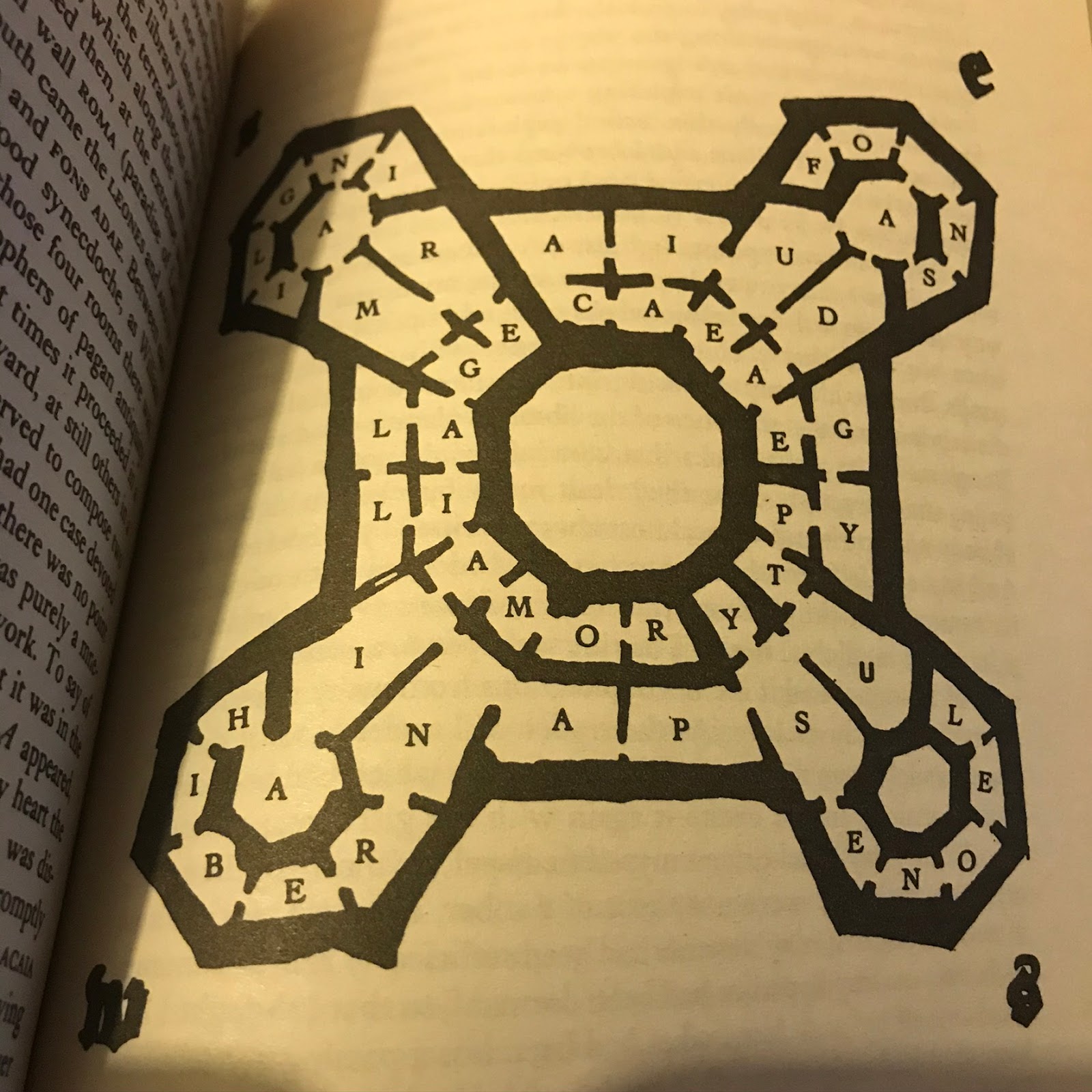
Until then I had thought each book spoke of things, human or divine, that lie outside books. Now I realized that not infrequently books speak of books: it is as if they spoke among themselves. In the light of this reflection, the library seemed all the more disturbing to me. It was then the place of a long, centuries-old murmuring, an imperceptible dialogue between one parchment and another, a living thing, a receptacle of powers not to be ruled by a human mind, a treasure of secrets emanated by many minds, surviving the death of those who had produced them or had been their conveyors.. . . . .
“The good of a book lies in it being read. A book is made up of signs that speak of other signs, which in their turn speak of things. Without an eye to read them, a book contains signs that produce no concepts; therefore it is dumb. This library was perhaps born to save the books it houses, but now it lives to bury them.” [150]
I said, in a confused way, and almost denying to myself the truth of what I felt, that the poor, filthy, and impudent creature who sold herself (who knows with what stubborn constancy) to other sinners, the daughter of Eve, weak like her sisters, who had so often bartered her own flesh, was yet something splendid and wondrous. My intellect knew her as an occasion of sin, my sensitive appetite perceived her as the vessel of every grace. It is difficult to say what I felt. I could try to write that, still caught in the snares of sin, I desired, culpably, for her to appear at every moment, and I spied on the labour of the workers to see whether, around the corner of a hut or from the darkness of a barn, that form that had seduced me might emerge. But I will not be writing the truth, or, rather, I would be attempting to draw a veil over the truth to accentuate its force and clarity. Because the truth is that I “saw” the girl, I saw her in the branches of the bare tree that stirred lightly when a benumbed sparrow flew to seek refuge there; I saw her in the eyes of the heifers that came out of the barn, and I heard her in the bleating of the sheep that crossed my erratic path. It was as if all creation spoke to me of her, and I desired to see her again, true, but I was also prepared to accept the idea of never seeing her again, and of never lying again with her, provided that I could savour the joy that filled me that morning and have her always near me even if she were to be, and for eternity, distant.
It was, now I am trying to understand, as if – just as the whole universe is surely like a book written by the finger of God, in which everything speaks to us of the immense goodness of its Creator, in which every creature is description and mirror of life and death, in which the humblest rose becomes a gloss of our terrestrial progress – everything, in other words, spoke to me only of the face I had hardly glimpsed in the aromatic shadows of the kitchen. I dwelled on these fantasies because I said to myself (or, rather, did not say: at that moment I did not formulate thoughts translatable into words) that if the whole world is destined to speak to me of the power, goodness, and wisdom of the Creator, and if that morning the whole world spoke to me of the girl, who (sinner though she may have been) was nevertheless a chapter in the great book of creation, a verse of the great psalm chanted by the cosmos – I said to myself (I say now) that if this occurred, it could only be part of the great theophanic design that sustains the universe, arranged like a lyre, miracle of consonance and harmony. As if intoxicated, I then enjoyed her presence in the things I saw, and, desiring her in them, with the sight of them I was sated. [178-9]
Oh, but she never wanted James to grow a day older or Cam either. These two she would have liked to keep for ever just as they were, demons of wickedness, angels of delight, never to see them grow up into long-legged monsters. Nothing made up for the loss. [67-68]

