Cosy nook. Fun concept! Newest crush. ;)
Tuesday, 18 June 2019
Thursday, 23 May 2019
Thursday, 16 May 2019
Sunday, 5 May 2019
Spring reading,
05/05 I'd been wanting to read Red Dust Road ahead of its NTS tour later this year. And what a joy it was: a voyage of discovery; of parentage & self & identity.
Kicking the story off with the drama of re-meeting her birth father; tracing that moment back in the quest to re-discover her roots and whom, what kind of people, her birth parents are; the plot weaving in & out of childhood memories,
* Incidents of race and difference from growing up & becoming; the love and regard for her adoptive ('true') parents & the aunts from Nairn; the disappointments of ideals held when reality hits, of opportunities just missed; the camaraderie & care of her friends & new friendships forged helping her find a way across Nigeria; that joyful rendezvous with Sidney, her brother, opening up a new world of possibility and re-connection to her wider Nigerian family.
* Reflections on memory (that well-known, well-used family refrain of "remember that time when...?" to relive a moment from childhood); of her parents' relationship - "my parents reinforce each other with memory" as well as their fragility & mortality. * Hitting the nail square on the head with regards to Aberdeen - "depressingly dull or majestic & magical" ... "either the colour of sparkling silver or the drab colour of porridge or fog, depending on your way of seeing it." (132).
Favourite extracts:
Part of me came from Africa, part of me was foreign to myself, strange to myself since I have never been to the dark continent and could only really have it burning away, hot and dusty, in my mind. It is not so much that being black in a white country means that people don’t except you as, say Scottish; it is that being black in a white country makes you a stranger to yourself. It is not the foreigner without; it is the foreigner within that is interesting. Every time somebody in your own country asks you where you are from; every time you indignantly reply, ‘I’m from here,’ you are subconsciously caught up in asking that question again and again of yourself, particularly when you are a child. (38)
I pictured of the plots of my land in the African landscape of my imagination. It was flat land, not like the Highlands of Scotland. The earth was dark and rich. There was a red dust road. I couldn’t really get much further than that. (42)
... And no matter how much she loved me, no matter how much my dad loved me, there is still a windy place right at the core of my heart. The windy place is like Wuthering Heights, out on open the moors, rugged and wild and free and lonely. The wind rages and batters at the trees. I struggle against the windy place. I sometimes even forget it. But there it is. I am partly defeated by it. You think adoption is a story which has an end. At the point about it is that it has no end. It keeps changing its ending. It infuriates me that this windy place exists at all. It shouldn’t. ... I am lucky. I am blessed. And yet still, sometimes, in my dark hours, there is this feeling that I am alone. And I can’t shake it. There’s this ghostly something. I’m only alone in the way that everybody is alone. And yet it seems that the bundle of a child that is wrapped up in the ghostly shawl of adoption does have another layer of aloneness wrapped up in there. (45-46)
Why do we even want to know; surely we know ourselves by now? Why should we have any curiosity, never mind the blazing burning curiosity, the all-consuming insatiable appetite for self-knowledge that some of us feel? If we think of ourselves as puzzles, and our birth parents are part of that puzzle, do we think that finding our parents will answer the puzzle? Surely we are not so naive? The jigsaw can never, ever be completed there will always be missing pieces, or the pieces will be too large and clumsy to fit into the delicate puzzle … You are made already, though you don’t properly know it, you are made up from a mixture of myth and gene. You are part fable, part porridge. (47)
I take off my shoes so the red earth can touch my bare soles. It’s as if my footprints were already on the road before I even got there. I walk into them, my waiting footprints. The earth is so copper warm and beautiful and the green of the long elephant grasses so lushly green they make me want to weep. I feel such a strong sense of affinity with the colours and the landscape, a strong sense of recognition. There is a feeling of liberation, and exhilaration, that at last, at last, last I’m here.... The road welcomes me; it is benevolent, warm, friendly, accepting and for now it feels enough, the red, red of it, the vivid green against it, the long and winding red-dust road. (213-214)
The empty ghost, the wraithlike figure that has stalked me for years seems to be taking off her pale polka-dot dress, slowly, in the sports stadium changing rooms, and hanging it onto a peg. She opens a locker, with her own key, found after years of fumbling, and disappears into its depths. (276)
Kay, Jackie. Red Dust Road.
Picador: London, 2010.
. . . . .
28/04 I cannot remember how I first heard of Fishbowl. It may have been a mention in the Guardian Books pages perhaps when it first came out in 2015. Either way, its premise caught my attention & amused me so I jotted its name down as a future read. Looking for a remedy book, something to ease me back into reading after MN&JS had taken its toll, I found Fishbowl was in stock at the library. Perfect!
Chapter Two: "Ian doesn't take his plunge from the balcony until chapter 54" raised a smile. - Okay, Bradley Somer, we're with you; you master of intrigue, you.
What a read. Witty, philosophical, heart-warming.
It takes a goldfish less than four seconds to fall the distance between the twenty-seventh floor and the sidewalk below. A flash. The time it takes to read a sentence or two. For Ian, it's a lifetime of wonder.
... I loved how the novel was both four seconds long and yet simultaneously months, years old. The clever weaving-in & out of characters and story-line; pausing each one to return to Ian's apparently imminent demise: the high drama of Connor/Katie/Faye especially and the background to, and resolution of, Claire's story.
Lives intersecting, crisscrossing rooms, corridors and streets close by the apartment; "a glimpse into the box" ... Ian's fall serving as a "vital thread that ties humanity together."
That twist in the tale come the ending.
Brilliant.
. . . . .
a brilliant bonkers journey of binaries
Emma Rice's debut play came to town. A chapter a night ahead of watching the performance. Characters I loved, was rooting for, cheering on from the sidelines.
Great humour, warmth & escapades and a love letter to Shakespeare of sorts.
Glad to know of the nuances which time on stage could not allow for (the chapter on America omitted entirely); the cleverness in tying up the ending. (Ah Perry!)
. . . . .
25/02 I wanted to like this book. After all, a big chunky read; a epic of sorts. A book that had already been dramatised for tv. A book that promised a collision of worlds, of magic and society, with an ironic Austen-esque eye cast over its proceedings.
At times, the plot development caught me up & kept me page-turning; at times, the pace felt to lag & I stalled somewhat but still, would persevere & keep going.
Then two things occurred:
- I found myself so irritated by the character of the man with the thistle-down hair that (with a cheating glance to a plot outline), I discovered he wasn't due to die for at least another hundred pages. Ugh, time for a break.
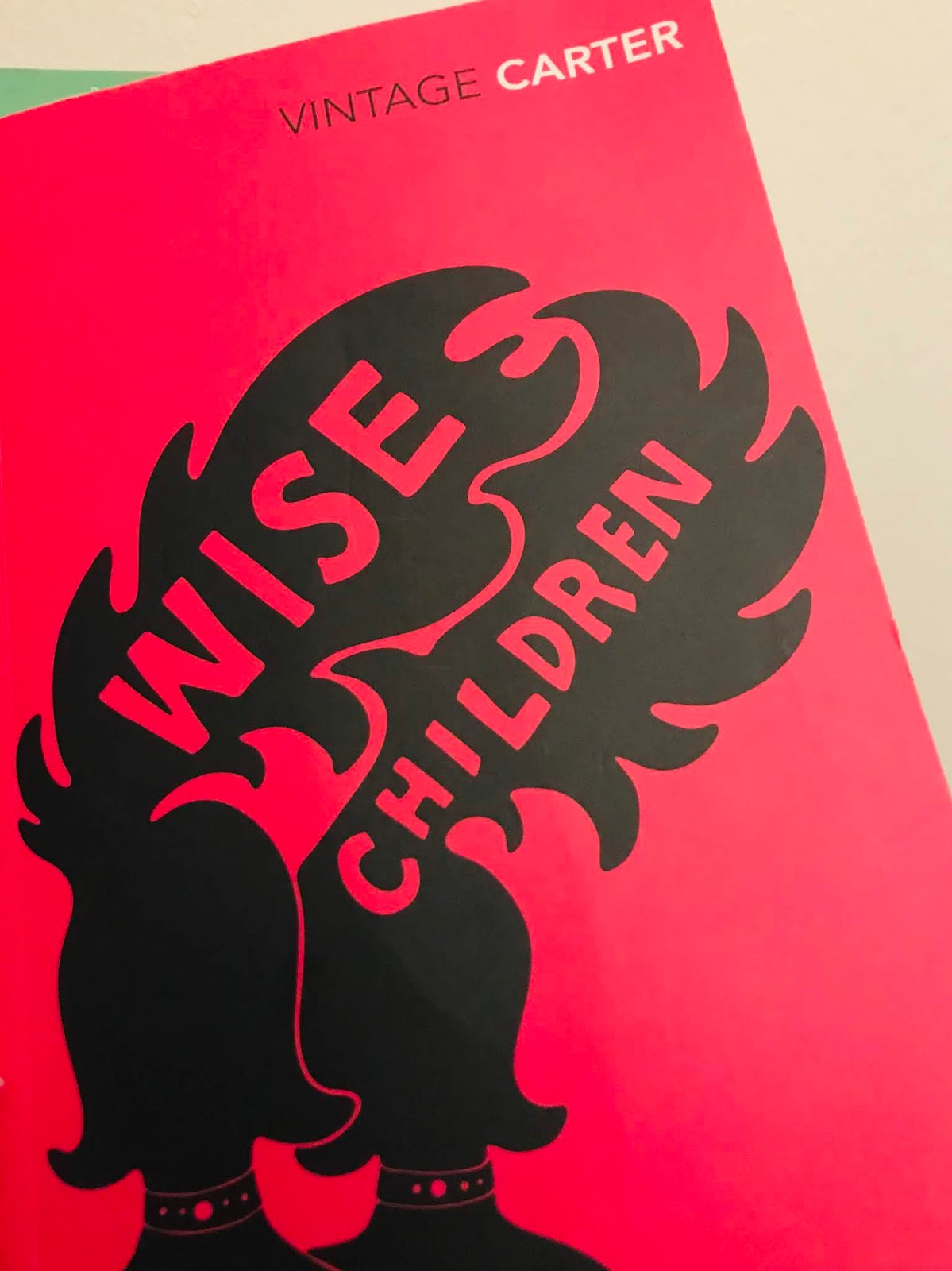
- I swapped over to Wise Children & found it an absolute riot. When I'd finished that brilliant bonkers journey of binaries, MN&JS was still sat waiting on my nightstand. I found myself putting off picking it up again. A couple of weeks passed and so, as much I dislike not finishing a read, that book was putting me off reading altogether. High time to quit & find another, more engaging read. A world I wanted to enter & enjoy.
.... I wanted to agree & join the crowd of admirers, Gaiman at the front leading the fanfare but. Life's too short to read 'bad' books. Not one for me. Off to the charity shop it went to become someone else's cup of tea instead.
Labels:
austen,
autobiography,
book-into-play,
book-into-tv,
library read
Location:
Manchester, UK
Wednesday, 23 January 2019
Well-thumbed; JW.
Brilliant.
Lyrical. Witty. Authentic. Eye-opening.
Shining a light on what she writes, why she
writes & how she writes.
Intertextual; a love of literature.
Life in Accrington I'd known about & likewise of her time in Oxford due to ground covered in Oranges.
But the breakdown? Writing her way out of it; figuring through. That particular
chapter, The Night Sea Voyage, came up like a sharp left turn
for the reader.
Moving. Engaging. The recriminatory
conversational creature. Courageous.
The adoption papers trail; making the novel
more than ever into a compelling page-turner.
There were so many lines too, thoughts
& themes which I wanted to savour. As the above photo shows, the closer I
moved towards the ending, the more I felt struck by & wanted to
revisit.
______________________
.. In the morning there were stray bits of texts all over the yard and in the alley. Burnt jigsaws of books. I collected some of the scraps.
It is probably why I write as I do - collecting the scraps, uncertain of continuous narrative. What does Eliot say? These fragments have I shored against my ruin . . .
[41]
12. THE NIGHT SEA VOYAGE
... Life is layers, fluid, unfixed, fragments. I never could write a story with a beginning, a middle & an end in the usual way because it felt untrue to me. That is why I write as I do and how I write as I do. It isn't a method; it's me. [...]
Whenever I write a book, one sentence forms in my mind, like a sandbar above the waterline. They are like the texts written up on the walls when we all lived at 200 Water Street; exhortations, maxims, lighthouse signals flashed out as a memory and warning.
The Passion: 'I'm telling you stories. Trust me.'
Written on the Body: 'Why is the measure of love loss?'
The PowerBook: 'To avoid discovery I stay on the run. To discover things for myself, I stay on the run.' [156]
... Then a string of lines start replaying in my head - lines from my own books - 'I keep writing this so that one day she will read it.' 'Looking for you, looking for me, I guess I've been looking for us both all my life . . . '
I have written love narratives and loss narratives - stories of longing and belonging. It all seems so obvious now - the Wintersonic obsessions of love, loss and longing. It is my mother. It is my mother. It is my mother. [160]
... Life is layers, fluid, unfixed, fragments. I never could write a story with a beginning, a middle & an end in the usual way because it felt untrue to me. That is why I write as I do and how I write as I do. It isn't a method; it's me. [...]
Whenever I write a book, one sentence forms in my mind, like a sandbar above the waterline. They are like the texts written up on the walls when we all lived at 200 Water Street; exhortations, maxims, lighthouse signals flashed out as a memory and warning.
The Passion: 'I'm telling you stories. Trust me.'
Written on the Body: 'Why is the measure of love loss?'
The PowerBook: 'To avoid discovery I stay on the run. To discover things for myself, I stay on the run.' [156]
I have written love narratives and loss narratives - stories of longing and belonging. It all seems so obvious now - the Wintersonic obsessions of love, loss and longing. It is my mother. It is my mother. It is my mother. [160]
. . .
On text memorised,
I had lines inside me - a string of guiding lights. I had language.
[9]
4. THE TROUBLE WITH A BOOK . . .
At home one of the six books was unexpected: a copy of Morte d’Arthur by Thomas Mallory. It was a beautiful edition with pictures, and it had belonged to a bohemian, educated uncle [...]
I have gone on working with the Grail stories all my life. They are stories of loss, of loyalty, of failure, of recognition, of second chances. [...]
Later, when things were difficult for me with my work, and I felt that I had lost it turned away from something I couldn’t even identify, it was the Perceval story that gave me hope. There might be a second chance . . .
I have gone on working with the Grail stories all my life. They are stories of loss, of loyalty, of failure, of recognition, of second chances. [...]
Later, when things were difficult for me with my work, and I felt that I had lost it turned away from something I couldn’t even identify, it was the Perceval story that gave me hope. There might be a second chance . . .
[37-8]
So when people say that poetry is a luxury, or an option, or for the educated middle classes, or that it shouldn’t be read at school because it is irrelevant, or any of the strange stupid things that are said about poetry and its place in our lives, I suspect that the people doing the saying have had things pretty easy.
A tough life needs a tough language - and that is what poetry is. That is what literature offers - a language powerful enough to say how it is.
It isn’t a hiding place. It is a finding place.
A tough life needs a tough language - and that is what poetry is. That is what literature offers - a language powerful enough to say how it is.
It isn’t a hiding place. It is a finding place.
[40]
I looked out and it didn’t look like a mirror or a world. It was the place I was, not the place where I would be. The books had gone, but they were objects; what they held could not be so easily destroyed. What they held was already inside me, and together we would get away. [...]
‘Fuck it,’ I thought, ‘I can write my own.’
[43]
5. AT HOME
Books, for me, are a home. Books don't make a home - they are one, in the sense that just as you do with a door, you open a book, and you go inside. Inside there is a different kind of time and space.
There is warmth there too - a hearth. I sit down with a book and I am warm. I know this from the chilly nights on the doorstep.
12. THE NIGHT SEA VOYAGE
On bad days I just held onto the thinning rope.
The rope was poetry. All that poetry I learned when I had to keep my library inside of me now offered a rescue rope.
[...]
But what is really your own never does leave you. I could not find words, not directly, for my own state but every so often I could write, and I did so in lit-up explosions, that for a time showed me that there was still a world - proper and splendid.
It was a rope slung across space. It was a chance as near to killing me as to saving me and I believe it was an even bet which way it went. It was the loss of everything through the fierce and unseen return of the lost loss. The door into the dark room had swung open. [...]
The rope was poetry. All that poetry I learned when I had to keep my library inside of me now offered a rescue rope.
[...]
But what is really your own never does leave you. I could not find words, not directly, for my own state but every so often I could write, and I did so in lit-up explosions, that for a time showed me that there was still a world - proper and splendid.
[163]
It was a rope slung across space. It was a chance as near to killing me as to saving me and I believe it was an even bet which way it went. It was the loss of everything through the fierce and unseen return of the lost loss. The door into the dark room had swung open. [...]
The door had swung open. I had gone in. The room had no floor. I had fallen and fallen and fallen.
But I was alive.
And that night the cold stars made a constellation from the broken pieces of my mind.
[169]
14. THIS APPOINTMENT TAKES PLACE IN THE PAST
[185]
15. THE WOUND
All my life I have worked from the wound. To heal it would mean an end to my identity - the defining identity. But the healed wound is not the disappeared wound; there will always be a scar. I will always be recognisable by my scar.
[223]
Winterson, Jeanette. Why Be Happy When You Could Be Normal?.
Vintage: London, 2012
Labels:
biography,
books-about-books,
epic reads,
extracts,
Winterson
Monday, 31 December 2018
My Year In Books : 2018
I’m A Big Brother - Joanna Cole
Rabbit’s Nap - Julia Donaldson
Pooh’s Christmas Adventure - Andrew Grey
Thomas & Friends: The Snowy Surprise
Sincerity - Carol Ann Duffy
The Bees - Carol Ann Duffy
Starter for Ten - David Nicholls
Hamilton: The Revolution - Lin-Manuel Miranda, Jeremy McCarter
R.U.R. (Rossumovi Univerzální Roboti) - Karel Čapek
On Chesil Beach - Ian McEwan
What the Ladybird Heard - Julia Donaldson
Shakespeare's The Tempest
Natasha's Dance: A Cultural History of Russia - Orlando Figes
The Goldfinch - Donna Tartt
Miss Peregrine's Home for Peculiar Children - Ransom Riggs
Circle Mirror Transformation - Annie Baker
The Scarlet Pimpernel - Baroness Orczy
One True Story - Tim Chester
Saturday, 10 November 2018
Saturday, 6 October 2018
S4T.
It was alright.
I picked it up in August, in a charity shop because back when I was a Netflix subscriber, I had added the McAvoy film to my To View list but had never quite got around to watching it. So I thought I'd start from the other end; that is to say, the beginning, in reading the book.
To be fair, I should add in a disclaimer that One Day also inspired a mediocre response from me so Nicholls isn't exactly one of my favourite authors. My response in both cases has been one of wanting to shake some sense into his characters, to "get it together!" so perhaps whereas others may find their qualities familiar or endearing; for me, that's just not the case.
I'll probably pass on the film altogether now, especially with having read how the plot-line diverges from the text. At least Nicholls' ending showed some degree of sense.
I picked it up in August, in a charity shop because back when I was a Netflix subscriber, I had added the McAvoy film to my To View list but had never quite got around to watching it. So I thought I'd start from the other end; that is to say, the beginning, in reading the book.
To be fair, I should add in a disclaimer that One Day also inspired a mediocre response from me so Nicholls isn't exactly one of my favourite authors. My response in both cases has been one of wanting to shake some sense into his characters, to "get it together!" so perhaps whereas others may find their qualities familiar or endearing; for me, that's just not the case.
I'll probably pass on the film altogether now, especially with having read how the plot-line diverges from the text. At least Nicholls' ending showed some degree of sense.
Thursday, 12 July 2018
Subscribe to:
Posts (Atom)