The Enormous Turnip - Katie Daynes & Georgien Overwater
Giraffe on a Bicycle - Julia Woolf
*Becoming - Michelle Obama
Paddington & the Christmas Surprise - Michael Bond
Austenland - Shannon Hale
Sourdough - Robin Sloan
The Strange Undoing of Prudencia Hart - David Greig
Hugless Douglas - David Melling
Busy People: Astronaut - Lucy M. George & AndoTwin
King of the Mountain: Fireman Sam - Adam Long
Little Miss Magic; Mr. Tickle in a Tangle - Roger Hargreaves
One Hundred Steps: The Story of Captain Tom Moore
- illus. Adam Larkum
Our House - Louise Candlish
The Golden Thread - Kassia St Clare
The Wild Places - Robert MacFarlane
The Patchwork Quilt - Valerie Flournoy & Jerry Pinkney
You’re Called What? - Kes Gray & Nikki Dyson
Oi, Puppies - Kes Gray & Jim Field
Knowing God - J.I. Packer
How to raise a loaf & fall in love with sourdough - Roly Allen
Friday, 31 December 2021
My Year In Books: 2021
Wednesday, 1 December 2021
'Sourdough' | Autumn '21
Sourdough bread begins with sourdough starter, which is not merely living but seething. It is a community of organisms comprised of, at minimum, yeast, which is a fungus, and lactobacillus, a bacteria. They eat flour — its sugars — and poop out acid — thus, sour — in addition to, carbon dioxide which, trapped by stretchy, glutenous dough, gives the bread an airy structure, the so-called crumb, at its prettiest a dazzling network of gaps and chambers. [37]

Being a sourdough afficionado, Sloan’s novel had me laughing out loud in recognition of the tricksy behaviour displayed by its wild yeast & Lois’ endeavours to understand it better. Oh yes.
… I set out my tools. I donned my apron. Everything was in order, and I was ready to produce a beautiful, burnished loaf just like Broom’s on the cover of his book. There were detailed instructions. I love detailed instructions. My whole career was detailed instructions. Precisely specified actions, executed in order. A serene confidence settled over me. I mixed the ingredients together, and immediately the project collapsed into chaos and disaster. Where the bread book showed a lump of dough folded elegantly into itself, I looked upon a twisted mutant mass. [39]
Not to mention the perils in attempt to perfect your loaf.
Optimism, dashed:
Where the bread book showed Everett Broom’s clean fingers deftly maneuvering said lump, my hands soon wore thick gauntlets of glop. I waved them over the sink, tried to shake some of it loose. Where the bread book showed a rustic work surface smartly maintained, I looked on a cramped and dingy countertop filmed with slime. There was dough on the cupboards. Dough on the faucet. Dough on the floor. It looked like a scene of a glutenous murder committed by a careless killer. [39]
The joy when a bake is executed & the desire to share, share, share. Dropping by, turning up unannounced on people's doorsteps; posting hot cross buns through a letterbox if they're out.
IT’S ALWAYS NEW AND ASTONISHING when it’s yours. Infatuation; sex; card tricks. How many humans have baked how many loaves of bread across how many centuries? I’m sure Beoreg baked calmly, matter-of-factly, without paroxysms of cosmic delight. But that didn’t matter. For me, the novice, the miracle was intact, and I felt compelled by some force — new to me, thrillingly implacable — to share. I tied the sliced loaves into neat bundles with twine and bounded outside, still wearing sweatpants I’d slept in. [45]
_________
i./ I followed the scent to the kitchen, where the Clement Street starter had more than doubled in volume and was surging out of the crock, puffy tendrils oozing down the green ceramic. I heard a crispy, crackling pock-pock-pock; the starter was not merely bubbling but frothing. It is only barely anthropomorphization to say it looked happy. I could understand that. [50]
ii./ At Beo’s urging, I upgraded my flour …
The Clement Street starter loved it.
It groaned and luxuriated. It belched ecstatically. [133]


I’d known the Clement Street starter wasn’t normal, of course but I honestly hadn’t realised the depth of its strangeness until now, because the King Arthur starter was very normal.He was happy and dopey like a big brown dog. It had no special high-maintenance desires it just wanted to grow.I let it. [221]
So well observed & rendered. What else?
- Number one eater!
- Lois' workplace at General Dexterity
- Peter & the Slurry as a counter to her sourdough
- The Lois Club
In fact, it's such a well-peopled novel. I loved how richly Sloan draws his characters with a bunch of quirks and idiosyncrasies thus rendering them fully human. Lois' different interactions and relationships with a range of people:
Beoreg & Chaiman. Chef Kate. The Loises. Lily Belasco. Horace & his library (a character in its own right).Carl & the Omebushi. Mr. Marrow. Jim Bascule. Charlotte Clingstone. Agrippa & his goats.
Key favourite points in the novel's development:
- Lois building the Jay Steve Value Oven
- The hurdles she faces whilst applying for the Farmers Market
- Email interludes with updates through Beo's correspondence - perfectly pitched -
&, in that, learning more about the Mazg & how the CS Starter came into being
- How the novel uses intrigue & frames Lois as a detective, investigating the Starter's history. The physical journeys to connect with others whilst on a journey of self-discovery herself.
... I finished Sourdough & now have Mr. Penumbra's 24-Hour Bookstore lined up for later. :)
Sloan, Robin. Sourdough. Atlantic Books: London, 2018
Thursday, 25 November 2021
Autumn Stack | 2

There are so many words involved in being a bibliophile and by that, I don’t mean the words themselves but more so about the process of reading, of stocking up To Read piles.
I was nearing the end of Sourdough & wasn’t quite ready for the book to be over. Which got me wondering whether there was a word too, for prolonging an ending & resisting its conclusion?
So I paused my reading progress & looked around for another so I could still stay within the un-concluded realms of Lois Clay, the Clement Street starter & the Vitruvian.
Chancing across the Bookery, I’d picked up Austenland. A Mr Darcy theme; hopefully a fun, lighter read when in between books. Or avoiding endings.
I liked it enough.
You do have to suspend your disbelief to get behind the concept that women would pay actual money to sign up for a Regency immersion experience with its rigid Code of Conduct.
Interlinking chapters by boyfriend recaps certainly aids the reader’s appreciation of Jane’s past love affairs: the crushes, the relationships, the disappointments.
But it did also bug me at times… I sincerely hope to never read another ‘Zing!’ in my life. Not the most believable of interior monologue moments, however heroine Jane is finding her way through proceedings.
I also wondered if Hale was consciously over-egging the pudding with her signifiers of the fact that the grumpiest man in the room couldn’t possibly be a love interest despite the very characteristic being stamped through as Total Darcy. Perhaps the reader is meant to know she can only be fooling herself but then wouldn’t an Austen reader be far smarter about that?
Having Martin’s character with the IRL intrusion was a good foil however & — spoilers! — aided the neat twist that even that seemingly covert flirtation was still overseen & orchestrated as part of the package.
She had seen her life like an intricate puzzle, all the boyfriends like dominoes, knocking the next one and the next, an endless succession of falling down. But maybe that wasn’t it all. She’d been thinking so much about endings, she’d forgotten to allow for the possibility of the last one, one that might stay standing.
[192] Hale, Shannon. Austenland. 2007
I can take the novel’s tied-up-in-a-bow ending. Although my own learned experience rather resisted the flippancy present in “There’s bound to be work for an attractive British actor..”
— Yes, mate. No visa required, just come on in. Mm!
I discovered Hale's Alternate Endings later whilst reading further online. And well, a part of me could’ve easily taken Independent Jane instead, minus any kind of rom-com conclusion in its entirety.
That said, having seen a few clips of the movie's trailer, a confrontation in the airport between Jane’s Regency rivals strikes me as being much more palatable than say, having one’s apparent love interest fly halfway across the world to turn up on your doorstep. Romantic? Nah, sorry. Somewhat weird & stalker-ish? Mhmm…
I liked it enough; a fun, lighter read whilst between other books.
Monday, 8 November 2021

Sunday, 3 October 2021
Autumn Stack

The Wild Places
I first encountered Robert McFarlane being namechecked in an article from Guardian's Review (RIP). The writer had grouped together Daisy Johnson (Fens) with McFarlane's Underland alongside other authors writing similarly on landscape or wildness. In sharing my new-found insight, I discovered my bookish friends were strides ahead of me - had got the book, been to the Waterstones signing; fully immersed. Once known, I kept coming across him still in later works; through the beautiful, imaginative 'Lost Words collaboration with Jackie Morris.
TWP I found in my local eco-friendly store. I was bending below the shelf to recycle a small stash of occasional green milk bottle tops when I saw too the book exchange pile. From there, south then north; west to east on train journeys, tram journeys; plus a stint working away from home. McFarlane propped open over breakfast, weighted with knife & pepper pot to hold the page. Journeying myself, crossing through the sunny Peak District back to Manchester whilst reading of other journeys taken far further south.
A revelation, 'Wrath' means not 'anger', but 'turning-point' [Cape, 133],
& some choice extracts - -
Wildness, in Coleridge's account, is an energy which blows through one's being, causing the self to shift into new patterns, opening up new perceptions of life.
[Ridge, 209]
. . .
On The Gentle Art by Stephen Graham
Anyone who could sincerely observe that 'There are thrills unspeakable in Rutland, more perhaps than on the road to Khiva' was, in my opinion, to be cherished. Graham was also one among a line of pedestrians who saw that wandering & wondering had long gone together; that their kinship as activities extended beyond their half-rhyme. And his book was a hymn to the subversive power of pedestrianism: its ability to make a stale world seem fresh, surprising and wondrous again, to discover astonishment on the terrain of the familiar.
[Holloway, 230]
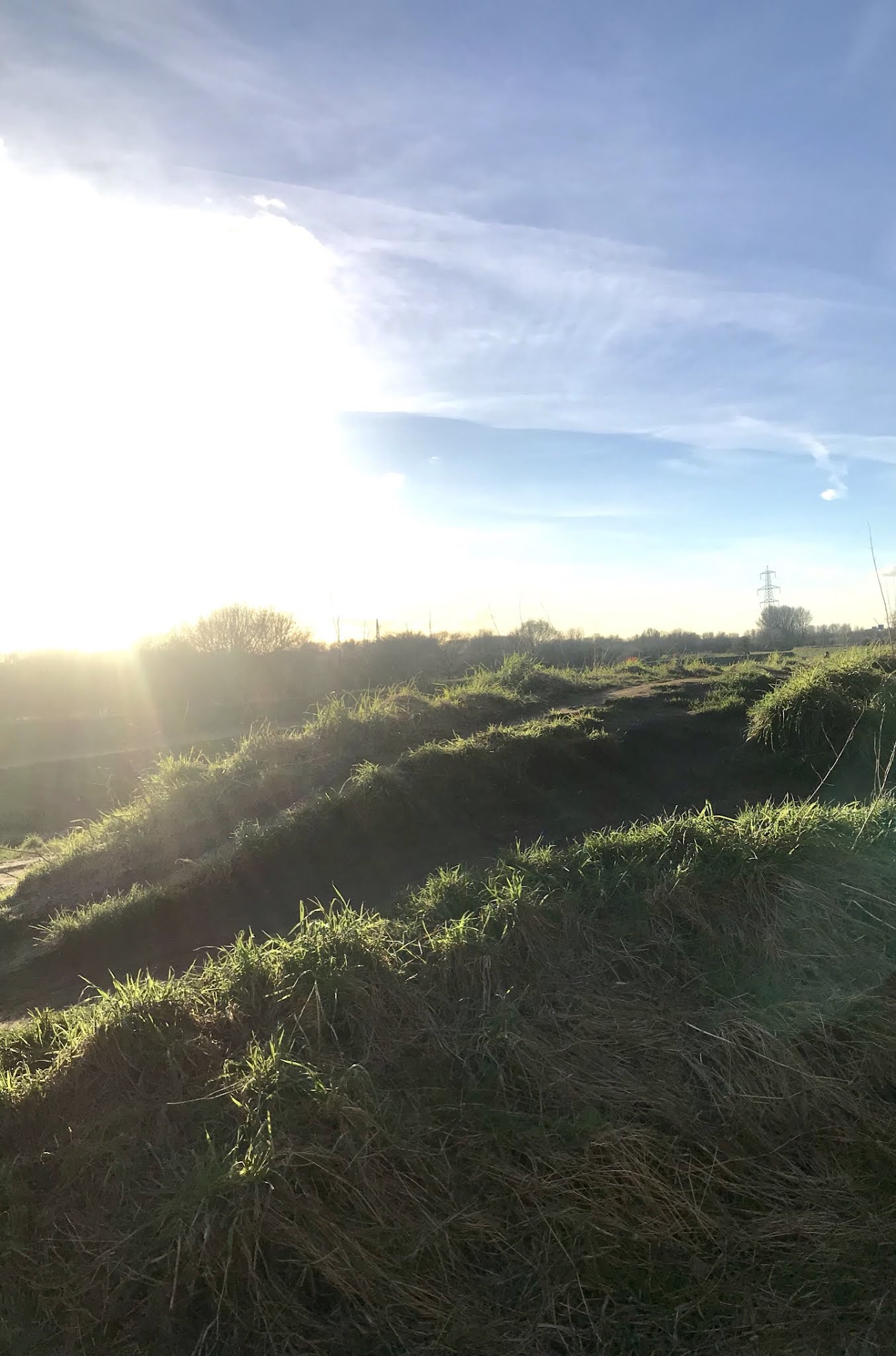
Most of these places .. were not marked as special on any map. But they became special by personal acquaintance. A bend in a river, the junction of four fields, a climbing tree.. a fragment of woodland glimpsed from a road regularly driven along - these might be enough. Or fleeting experiences, transitory, but still site-specific: [. . .] the fall of evening light upon a stone...
[. . .] It seemed to me that these nameless places might in fact be more important than the grander wild lands that for so many years had gripped my imagination. Taken together, the little places would make a map that could never be drawn by anyone, but which nevertheless existed.. I began to make a list in my head of what would be on my own map of private or small-scale wild places... [Holloway, 236-7]
> This fully engaged my attention as a reader. I may never climb a beech tree (my own climbing efforts ended in injury & a badly sprained ankle, aged 10) - nor attempt to scale Sgurr Dearg above Coruisk - nor sleep out on iced-over tarn in a blizzard in the Peaks [Ridge, 196, 199] ... but I can collate from memory a list of my very own places.
. . .
Grief played its tricks: I kept forgetting that he had died, thinking for a second I could ring him up to ask him something, or call over to see him. I had known him for fewer than four years, but friendship with Roger did not seem to follow the normal laws of time.
We had shared adventures, and there would have been others to come, but for the cancer.
I had wanted to know Roger as he aged into his seventies and eighties, for he would have grown old, properly old, so superbly. He was an expert in age: in its charisma and its worth. Everything he owned was worn, used, re-used. If anyone would have known how to age well, it would have been Roger. [Storm-Beach, 266-7]
_____________
"There is wildness everywhere if we only stop in our tracks & look around us."
~ Roger Deakin
. . . _____________ . . .
The Golden Thread
A bit of a voyage through time - & space.
A good read which educated & entertained.
Some stand-out chapters:
Surf Dragons - The Vikings Woollen sails
A King's Ransom: Wool in Medieval England
Solomon's Coats: Cotton, America & Trade
Workers in the Factory: Rayon's Dark Past
Some of what was unpacked I'd encountered of before - from social history, from C19th US Culture classes - but I enjoyed learning more of the specifics too. The challenges & obstacles faced across time by Vikings, peasants, enslaved African Americans with regards to cloth as well as the societal changes which fabric brought about.
Alongside these, the combination of the historic & the modern - how textiles were first deployed, then improved & developed for mountaineering & for space travel (Layering In Extremis & Under Pressure respectively).
. . . _____________ . . .
I could have lived without every single one of the hip hashtag social media malarkey which ended each chapters & grated horribly. Reveal of Saskia = Merle brought absolutely nothing to the plot line other than a bunch of wholly unnecessary additional pages. (Couldn't the women just have been friends? Was there really so much need for betrayal to solidarity?)
Thursday, 31 December 2020
My Year In Books: 2020
Time’s Arrow ~ Martin Amis
The Valley of Vision ~ Arthur G. Bennett
*The Golden Thread ~ Kassia St Clair
The Bell Jar ~ Sylvia Plath
Codename Villanelle ~ Luke Jennings
The Next Right Thing ~ Emily P. Freeman
The Pursuit of Love ~ Nancy Mitford
The Name of the Rose ~ Umberto Eco
Monday, 14 December 2020

Monday, 21 September 2020

Thursday, 20 August 2020

Monday, 15 June 2020
Spring Stack,
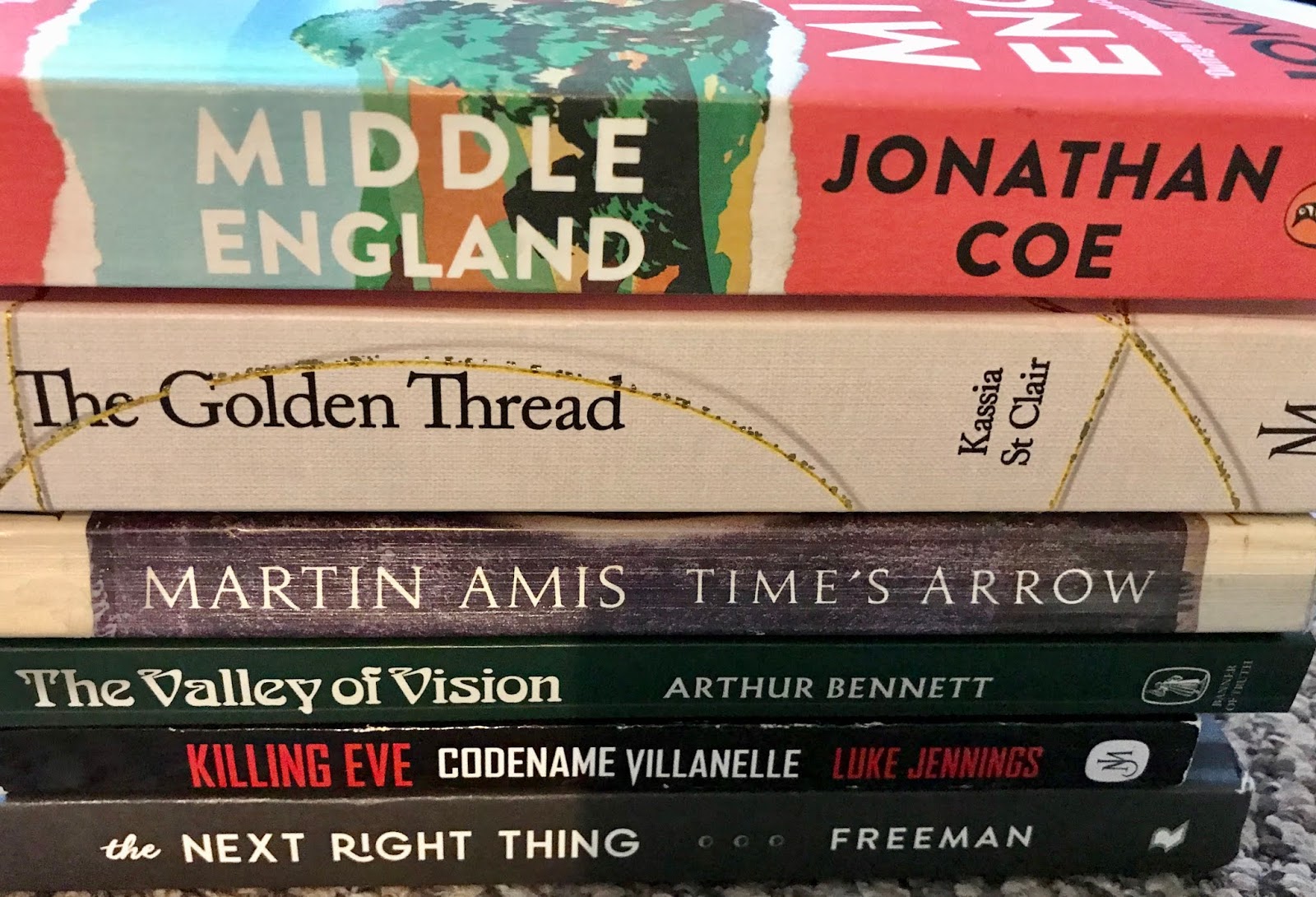
Middle England | Jonathan Coe
Aspects I liked: Sophie's study trip; Sophie's cruise.
The evening of the London 2012 Olympics, across the different households.
Benjamin & Doug were perhaps my two favourites in their roles of novelist & journalist.
Aspects I could've easily taken a pass on:
Sophie & Ian. Ian's mum. ... In fact, most of the cast list really as they were, for the most part, pretty disagreeable / selfish / presumptuous / niggling / plain bonkers...
Time's Arrow | Martin Amis
It's just as smart as I'd remembered. Sometimes I found myself reading conversations forward, from the bottom up so as to gain a sense of where the backwards conversation was headed / had come from. Amis' foreshadowing of elements such as the bomb baby works to spur the reader onwards, seeking to uncover this memory of the 'future past'.
'How many times have I asked myself: when is the world going to start making sense? Yet the answer is out there. It is rushing towards me over the uneven ground.' [123]
'Into Tod's mind, of course, I cannot see. But I am the hidden sharer of his body.' [64]My revisit of TA has made me want to return to some of Primo Levi's texts too.
Codename Villanelle | Luke Jennings
Interesting to learn - SPOILERS ALERT - more of Villanelle/Oxana’s childhood, her relationship with her father; to discover that Carolyn Martens was dreamed up as a female alternative to Eve’s inevitably male boss (thank god; the series is so much the better for having Fiona Shaw kick so much ass); discovering more of Eve & Nick’s relationship and finding, by the end, that it’s Konstantin who gets the shove and not the dangerous ex-lover.
The Next Right Thing | Emily P. Freeman
1. Martin Amis: Time's Arrow
Jonathan Cape, 1991.