Wednesday, 1 December 2021

'Sourdough' | Autumn '21

I started Robin Sloan's Sourdough on completion of another book & (having pulled myself through that one’s pages), just a page or two into this, I found I could exhale. Well-written & engaging; what a treat. A friend of mine, knowing me to be a baker, had recommended it to me a year or so ago.

Sourdough bread begins with sourdough starter, which is not merely living but seething. It is a community of organisms comprised of, at minimum, yeast, which is a fungus, and lactobacillus, a bacteria. They eat flour — its sugars — and poop out acid — thus, sour — in addition to, carbon dioxide which, trapped by stretchy, glutenous dough, gives the bread an airy structure, the so-called crumb, at its prettiest a dazzling network of gaps and chambers. [37]

Mhm. ðŸ¤©

Being a sourdough afficionado, Sloan’s novel had me laughing out loud in recognition of the tricksy behaviour displayed by its wild yeast & Lois’ endeavours to understand it better. Oh yes. 

… I set out my tools. I donned my apron. Everything was in order, and I was ready to produce a beautiful, burnished loaf just like Broom’s on the cover of his book. There were detailed instructions. I love detailed instructions. My whole career was detailed instructions. Precisely specified actions, executed in order. A serene confidence settled over me. I mixed the ingredients together, and immediately the project collapsed into chaos and disaster. Where the bread book showed a lump of dough folded elegantly into itself, I looked upon a twisted mutant mass. [39]

Not to mention the perils in attempt to perfect your loaf.
Optimism, dashed:

Where the bread book showed Everett Broom’s clean fingers deftly maneuvering said lump, my hands soon wore thick gauntlets of glop. I waved them over the sink, tried to shake some of it loose. Where the bread book showed a rustic work surface smartly maintained, I looked on a cramped and dingy countertop filmed with slime. There was dough on the cupboards. Dough on the faucet. Dough on the floor. It looked like a scene of a glutenous murder committed by a careless killer. [39]

The joy when a bake is executed & the desire to share, share, share. Dropping by, turning up unannounced on people's doorsteps; posting hot cross buns through a letterbox if they're out.

IT’S ALWAYS NEW AND ASTONISHING when it’s yours. Infatuation; sex; card tricks. How many humans have baked how many loaves of bread across how many centuries? I’m sure Beoreg baked calmly, matter-of-factly, without paroxysms of cosmic delight. But that didn’t matter. For me, the novice, the miracle was intact, and I felt compelled by some force — new to me, thrillingly implacable — to share. I tied the sliced loaves into neat bundles with twine and bounded outside, still wearing sweatpants I’d slept in. [45] 

_________ 

i./ I followed the scent to the kitchen, where the Clement Street starter had more than doubled in volume and was surging out of the crock, puffy tendrils oozing down the green ceramic. I heard a crispy, crackling pock-pock-pock; the starter was not merely bubbling but frothing. It is only barely anthropomorphization to say it looked happy. I could understand that. [50]
ii./ At Beo’s urging, I upgraded my flour …
The Clement Street starter loved it.
It groaned and luxuriated. It belched ecstatically. [133] 
Monstrous  ||  Happy bubbles indeed.
______
I’d known the Clement Street starter wasn’t normal, of course but I honestly hadn’t realised the depth of its strangeness until now, because the King Arthur starter was very normal. 
He was happy and dopey like a big brown dog. It had no special high-maintenance desires it just wanted to grow. 
I let it. [221]


So well observed & rendered. What else?

- Number one eater!
- Lois' workplace at General Dexterity
- Peter & the Slurry as a counter to her sourdough
- The Lois Club

In fact, it's such a well-peopled novel. I loved how richly Sloan draws his characters with a bunch of quirks and idiosyncrasies thus rendering them fully human. Lois' different interactions and relationships with a range of people: 

Beoreg & Chaiman. Chef Kate. The Loises. Lily Belasco. Horace & his library (a character in its own right).Carl & the Omebushi. Mr. Marrow. Jim Bascule. Charlotte Clingstone. Agrippa & his goats. 

Key favourite points in the novel's development:

- Lois building the Jay Steve Value Oven 
- The hurdles she faces whilst applying for the Farmers Market
- Email interludes with updates through Beo's correspondence - perfectly pitched - 
&, in that, learning more about the Mazg & how the CS Starter came into being
- How the novel uses intrigue & frames Lois as a detective, investigating the Starter's history. The physical journeys to connect with others whilst on a journey of self-discovery herself.

... I finished Sourdough & now have Mr. Penumbra's 24-Hour Bookstore lined up for later.  :) 

Sloan, Robin. SourdoughAtlantic Books: London, 2018

Thursday, 25 November 2021

Autumn Stack | 2

There are so many words involved in being a bibliophile and by that, I don’t mean the words themselves but more so about the process of reading, of stocking up To Read piles. 

I was nearing the end of Sourdough & wasn’t quite ready for the book to be over. Which got me wondering whether there was a word too, for prolonging an ending & resisting its conclusion?
  So I paused my reading progress & looked around for another so I could still stay within the un-concluded realms of Lois Clay, the Clement Street starter & the Vitruvian.
  Chancing across the Bookery, I’d picked up Austenland. A Mr Darcy theme; hopefully a fun, lighter read when in between books. Or avoiding endings. 

I liked it enough. 
You do have to suspend your disbelief to get behind the concept that women would pay actual money to sign up for a Regency immersion experience with its rigid Code of Conduct. 
Interlinking chapters by boyfriend recaps certainly aids the reader’s appreciation of Jane’s past love affairs: the crushes, the relationships, the disappointments. 

But it did also bug me at times… I sincerely hope to never read another ‘Zing!’ in my life. Not the most believable of interior monologue moments, however heroine Jane is finding her way through proceedings. 
   I also wondered if Hale was consciously over-egging the pudding with her signifiers of the fact that the grumpiest man in the room couldn’t possibly be a love interest despite the very characteristic being stamped through as Total Darcy. Perhaps the reader is meant to know she can only be fooling herself but then wouldn’t an Austen reader be far smarter about that?

Having Martin’s character with the IRL intrusion was a good foil however & — spoilers! — aided the neat twist that even that seemingly covert flirtation was still overseen & orchestrated as part of the package.

She had seen her life like an intricate puzzle, all the boyfriends like dominoes, knocking the next one and the next, an endless succession of falling down. But maybe that wasn’t it all. She’d been thinking so much about endings, she’d forgotten to allow for the possibility of the last one, one that might stay standing. 
                                                                                                                     [192] Hale, Shannon. Austenland. 2007

I can take the novel’s tied-up-in-a-bow ending. Although my own learned experience rather resisted the flippancy present in “There’s bound to be work for an attractive British actor..”  

— Yes, mate. No visa required, just come on in. Mm!

I discovered Hale's Alternate Endings later whilst reading further online. And well, a part of me could’ve easily taken Independent Jane instead, minus any kind of rom-com conclusion in its entirety. 
That said, 
having seen a few clips of the movie's trailer, a confrontation in the airport between Jane’s Regency rivals strikes me as being much more palatable than say, having one’s apparent love interest fly halfway across the world to turn up on your doorstep. Romantic? Nah, sorry. Somewhat weird & stalker-ish? Mhmm…

I liked it enough; a fun, lighter read whilst between other books.

Monday, 8 November 2021

Bookery!

This one's in my neighbourhood.  :D

Sunday, 3 October 2021

Autumn Stack

The Wild Places 
I first encountered Robert McFarlane being namechecked in an article from Guardian's Review (RIP).  The writer had grouped together Daisy Johnson (Fens) with McFarlane's Underland alongside other authors writing similarly on landscape or wildness.         In sharing my new-found insight, I discovered my bookish friends were strides ahead of me - had got the book, been to the Waterstones signing; fully immersed.  Once known, I kept coming across him still in later works; through the beautiful, imaginative 'Lost Words collaboration with Jackie Morris. 

TWP I found in my local eco-friendly store. I was bending below the shelf to recycle a small stash of occasional green milk bottle tops when I saw too the book exchange pile.  From there, south then north; west to east on train journeys, tram journeys; plus a stint working away from home.  McFarlane propped open over breakfast, weighted with knife & pepper pot to hold the page.  Journeying myself, crossing through the sunny Peak District back to Manchester whilst reading of other journeys taken far further south. 

A revelation, 'Wrath' means not 'anger', but 'turning-point' [Cape, 133], 
& some choice extracts - -

Wildness, in Coleridge's account, is an energy which blows through one's being, causing the self to shift into new patterns, opening up new perceptions of life. 
[Ridge, 209] 
. . . 

On The Gentle Art by Stephen Graham 
Anyone who could sincerely observe that 'There are thrills unspeakable in Rutland, more perhaps than on the road to Khiva' was, in my opinion, to be cherished. Graham was also one among a line of pedestrians who saw that wandering & wondering had long gone together; that their kinship as activities extended beyond their half-rhyme. And his book was a hymn to the subversive power of pedestrianism: its ability to make a stale world seem fresh, surprising and wondrous again, to discover astonishment on the terrain of the familiar.
[Holloway, 230]

> Reading this in 2021, a year on from the pandemic & impact of lockdown ... It's a sentiment many of us came to recognise or if not, remember through staying local, holding still and watching the seasons change in close proximity, in one's own neighbourhood. 

Most of these places .. were not marked as special on any map. But they became special by personal acquaintance. A bend in a river, the junction of four fields, a climbing tree.. a fragment of woodland glimpsed from a road regularly driven along - these might be enough. Or fleeting experiences, transitory, but still site-specific: [. . .]  the fall of evening light upon a stone...

 [. . .]   It seemed to me that these nameless places might in fact be more important than the grander wild lands that for so many years had gripped my imagination. Taken together, the little places would make a map that could never be drawn by anyone, but which nevertheless existed.. I began to make a list in my head of what would be on my own map of private or small-scale wild places...  [Holloway, 236-7]

>  This fully engaged my attention as a reader. I may never climb a beech tree (my own climbing efforts ended in injury & a badly sprained ankle, aged 10) - nor attempt to scale Sgurr Dearg above Coruisk - nor sleep out on iced-over tarn in a blizzard in the Peaks [Ridge, 196, 199] ... but I can collate from memory a list of my very own places.
. . . 

Grief played its tricks: I kept forgetting that he had died, thinking for a second I could ring him up to ask him something, or call over to see him. I had known him for fewer than four years, but friendship with Roger did not seem to follow the normal laws of time. 
We had shared adventures, and there would have been others to come, but for the cancer.
I had wanted to know Roger as he aged into his seventies and eighties, for he would have grown old, properly old, so superbly. He was an expert in age: in its charisma and its worth. Everything he owned was worn, used, re-used. If anyone would have known how to age well, it would have been Roger.  
[Storm-Beach, 266-7]

_____________

"There is wildness everywhere if we only stop in our tracks & look around us." 
~ Roger Deakin

. . .  _____________  . . . 

The Golden Thread
A bit of a voyage through time - & space. 
A good read which educated & entertained.

Some stand-out chapters: 
 
Surf Dragons - The Vikings Woollen sails
 A King's Ransom: Wool in Medieval England
 Solomon's Coats: Cotton, America & Trade
 Workers in the Factory: Rayon's Dark Past

Some of what was unpacked I'd encountered of before - from social history, from C19th US Culture classes - but I enjoyed learning more of the specifics too. The challenges & obstacles faced across time by Vikings, peasants, enslaved African Americans with regards to cloth as well as the societal changes which fabric brought about. 
Alongside these, the combination of the historic & the modern - how textiles were first deployed, then improved & developed for mountaineering & for space travel (Layering In Extremis & Under Pressure respectively). 

 . . . _____________ . . . 

Our House
Mmm. Yeah. 
No. )

It didn't help that this was my first fiction read in a long while & I was ready for something Good. I'd thought the premise sounded rather intriguing. But perhaps the  l a r g e  & thus easy-to-read, accessible nature should've sounded an even louder alarm bell as I started? 
At my most constructive, I'm going to say that when the plot hit its middle territory there was something of a recovered stride & so the tangled web became slightly more engaging.
I could have lived without every single one of the hip hashtag social media malarkey which ended each chapters & grated horribly. Reveal of Saskia = Merle brought absolutely nothing to the plot line other than a bunch of wholly unnecessary additional pages. (Couldn't the women just have been friends? Was there really so much need for betrayal to solidarity?)
A bit too much froth but hey, the same storyline came up in national news so the truth is certainly proven to be stranger than fiction & entirely plausible now, I guess.

Thursday, 31 December 2020

My Year In Books: 2020

The Nativity Play ~ Nick Butterworth & Mick Inkpen
A Christmas Story ~ Brian Wildsmith
Ruby the Donkey ~ Mirabel Cecil & Christina Gascoigne
Jesus’ Christmas Party ~ Nicholas Allen
The Adventures of Parsley the Lion ~ Michael Bond & Rob Biddulph
Glass, Irony & God ~ Anne Carson 
Ernest the Moose who doesn’t fit  ~ Catherine Rayner
*Knowing God ~ J.I. Packer 
While We Can’t Hug ~ Eoin McLaughlin & Polly Dunbar
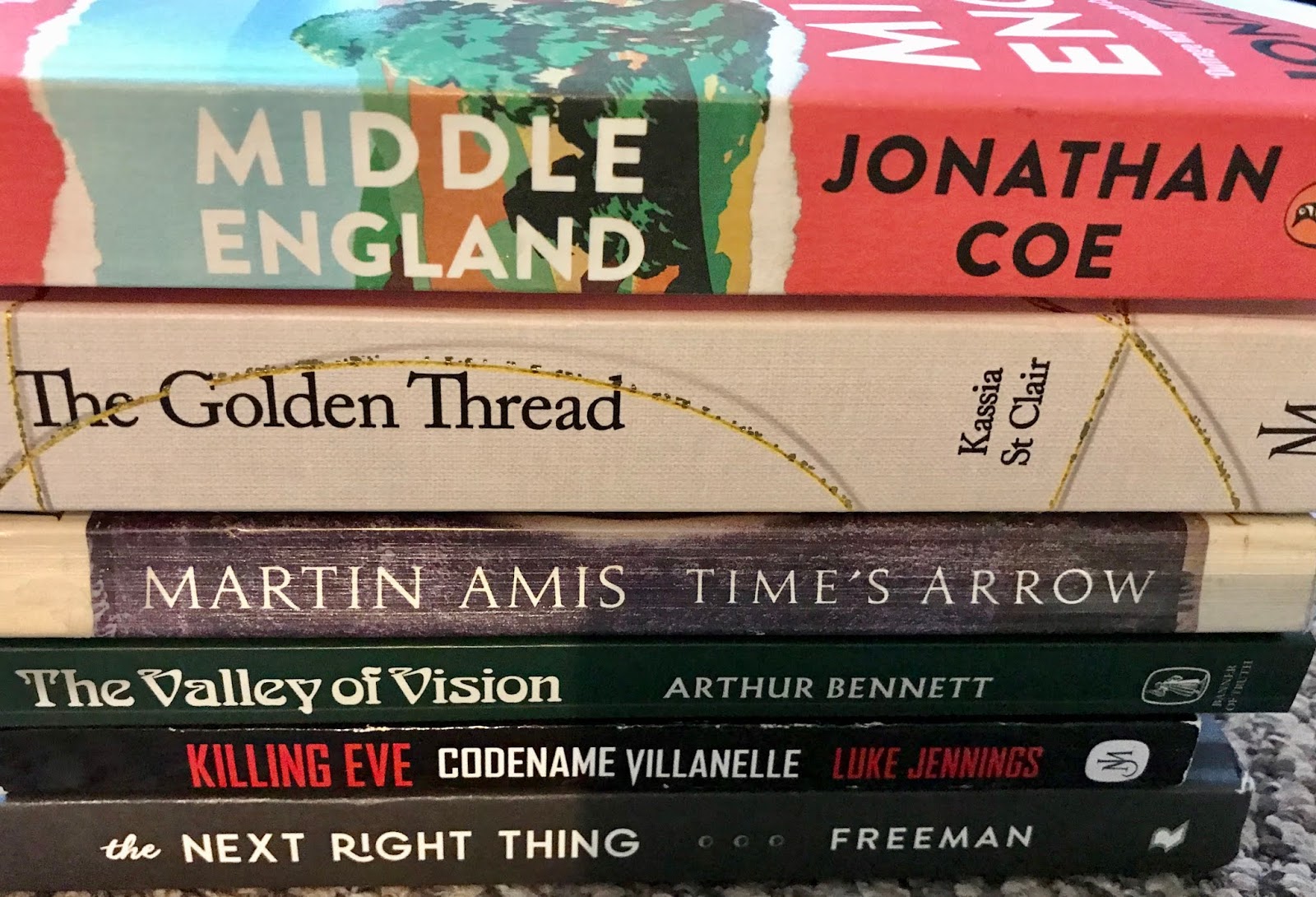
Middle England ~ Jonathan Coe
Time’s Arrow ~ Martin Amis
The Valley of Vision ~ Arthur G. Bennett
*The Golden Thread ~ Kassia St Clair
The Bell Jar ~ Sylvia Plath
Codename Villanelle ~ Luke Jennings
The Next Right Thing ~ Emily P. Freeman
The Pursuit of Love ~ Nancy Mitford
The Name of the Rose ~ Umberto Eco

Monday, 14 December 2020

Monday, 21 September 2020

Nutbrown.

26 years of this wonderful book. 
Thank you Sam McBratney (1943 - 2020).

Illustration: Anita Jeram

Thursday, 20 August 2020

Monday, 15 June 2020

Spring Stack,


Middle England | Jonathan Coe
...  Not a book I would've likely picked up myself but nonetheless a book lent to me by a friend: "it's about Brexit" ... & then some. Coe's array of characters, intersecting, made for some good dynamics & interesting relationships.
Aspects I liked: Sophie's study trip; Sophie's cruise. 
The evening of the London 2012 Olympics, across the different households. 
Benjamin & Doug were perhaps my two favourites in their roles of novelist & journalist.
Aspects I could've easily taken a pass on
Sophie & Ian. Ian's mum. ... In fact, most of the cast list really as they were, for the most part, pretty disagreeable / selfish / presumptuous / niggling / plain bonkers...

Time's Arrow | Martin Amis 
...  A good revisit. Last time I read the novel was in my final year as an undergrad. I'd remembered its connection to Betrayal, Benjamin Button - a narrative reversed but my memory had mashed it up with its progenitor, Slaughterhouse-Five.
  It's just as smart as I'd remembered. Sometimes I found myself reading conversations forward, from the bottom up so as to gain a sense of where the backwards conversation was headed / had come from. Amis' foreshadowing of elements such as the bomb baby works to spur the reader onwards, seeking to uncover this memory of the 'future past'. 

'How many times have I asked myself: when is the world going to start making sense? Yet the answer is out there. It is rushing towards me over the uneven ground.'  [123]
In the later phase of the book, my reading slowed as the Jewish race comes into being, 'created from the air' and Amis addresses the atrocity of poisons 'extracted' through the experiments of the protagonist, who has become, by this point: Odilo Unverdorben
  It's harder going in the penultimate chapters because what one reads stands in a false mirror of events: creation in lieu of destruction, birth in lieu of life. I'm glad that we, as readers, also have the soul's voice as our narrator, separating off body & flesh & negative action. 

  'Into Tod's mind, of course, I cannot see. But I am the hidden sharer of his body.'  [64]
My revisit of TA has made me want to return to some of Primo Levi's texts too. 


Codename Villanelle | Luke Jennings
A good insight into the foundations of what was used & tweaked by PWB to become the BBC tv programme, Killing Eve. 
Interesting to learn - SPOILERS ALERT - more of Villanelle/Oxana’s childhood, her relationship with her father; to discover that Carolyn Martens was dreamed up as a female alternative to Eve’s inevitably male boss (thank god; the series is so much the better for having Fiona Shaw kick so much ass); discovering more of Eve & Nick’s relationship and finding, by the end, that it’s Konstantin who gets the shove and not the dangerous ex-lover.


The Next Right Thing | Emily P. Freeman
... I'm not a massive fan of self-help books & Christian life application books (the Bible aside) sometimes make me feel like I've hit a wall. Not the easiest of things to concentrate on but Freeman's book got the best out of me. It's helped by the fact that the text & her podcast series also interconnect. So thanks to audio, a sense was gained of Freeman's outreach & overall approach: not an admonishment but an encouragement. A gentle nudge to retrain oneself to think differently, respond differently & to do so out of love.


1.  Martin Amis: Time's Arrow
     Jonathan Cape, 1991.

Monday, 6 April 2020

Spring reading,

1. The Mitford was given to me as a birthday gift late last year. Oh-so-pretty a cover & I really enjoyed the read too: tumultuous larger-than-life characters in childhood; impossibly escapist attitudes to marriage & romance. ... One of those novels which takes such a hold of your attention that suddenly it's 1am & yet you still don't want to put it down. It's curious than the sequel, Love in a Cold Climate is better known to me than this, its predecessor. I certainly want to read the other now.                     
Choice excerpts include...     
Sad and tired as Linda was, she could not but perceive the beauty of Paris that summer morning as she drove across it to the Gare du Nord. Paris in the early morning has a cheerful, bustling aspect, a promise of delicious things to come, a positive smell of coffee and croissants, quite peculiar to itself
    The people welcome a new day as if they were certain of liking it, the shopkeepers pull up the blinds serene in the expectation of a good trade, the workers go happily to their work, the people who have sat up all night in night clubs go happily to their rest, the orchestra of motor-car horns, clanking trams, a whistling policeman tunes up for the daily symphony, and everywhere is joy.
This joy, this life, this beauty did not underline poor Linda's fatigue and sadness, she felt it but was not of it. She turned her thoughts to old familiar London, she longed above all for her own bed, feeling as does a wounded beast when it crawls home to its lair. She only wanted to sleep undisturbed in her own bedroom. [131-2]
       . . . . .
“Oh, don’t pity me. I’ve had eleven months of perfect and unalloyed happiness, very few people can say that, in the course of long lives, I imagine.” 
I imagine so too. Alfred and I are happy, as happy as married people can be. We are in love, we are intellectually and physically suited in every possible way, we rejoice in each other’s company, we have no money troubles and three delightful children. And yet, when I consider my life, day by day, hour by hour, it seems to be composed of a series of pin-pricks. Nannies, cooks, the endless drudgery of housekeeping, the nerve-racking noise and boring repetitive conversation of small children (boring in the sense that it bores into one‘s very brain), their absolute incapacity to amuse themselves, their sudden and terrifying illnesses, Alfred’s not infrequent bouts of moodiness, his invariable complaint at the meals about the pudding, the way he will always use my toothpaste and will always squeeze the tube in the middle. These are the components of marriage, the wholemeal bread of life, rough, ordinary, but sustaining; Linda had been feeding upon honey-dew, and that is an incomparable diet.’ [169-170]

       . . . . .
Both [Tony & Christian] would have spoken to her exactly, in every respect, as if she had been some chap in the club. Fabrice talked to her, at her, and for only her, it was absolutely personal talk, scattered with jokes and illusions private to them both. She had a feeling that he would not allow himself to be serious, that if he did he would have to embark on tragedy, and that he wanted her to carry away a happy memory of his visit. But it also gave an impression of boundless optimism and faith, very cheering at that dark time. [177]

2. I'm now one chapter in to a non-fiction read, The Golden Thread. I'd spotted it last summer whilst table-browsing in The Little Ripon Bookshop* (which is an absolute delight, by the way) & had made a note of its name for later. There are paperbacks available but.... who'd willingly pass up on this gorgeous cover? I'm hoping it will pay literary dividends, bringing together my love of niche BBC4 factual documentaries & costuming combined.


*Also where I might've just had a fan girl moment on spotting Green Crayon.  Happily Drew Daywalt & Oliver Jeffers' book, The Day The Crayons Quit was nearby so I could provide my bemused friend with a speedy explanation.